





What Is B2B Sales?
B2B (business-to-business) sales is the practice of one business selling products, services, or solutions to another. It differs from B2C sales, in which a business sells products or services directly to private individuals.
Typical hallmarks of B2B sales include:
-
Higher pricing: B2B transactions can be priced in the millions. Some B2B sales are contractual, with significant investments over a period.
-
Longer sales cycles: B2B deals are often customized to the buyer and might feature multiple meetings and presentations with various stakeholders and extensive negotiations.
-
Multiple stakeholders: B2B sellers must navigate a variety of decision roles to close deals, up to and including C-suite executives.
- Increased complexity: All of these factors combined make for an environment in which every step in the sales process must be handled with care. High-value B2B sales with long sales cycles are often referred to as complex sales.
B2B sales is complex. No two sales are exactly alike, and sellers must adapt to changing circumstances while moving buyers through the process. With higher stakes and longer sales cycles in B2B sales, missteps can be costly.
And B2B sales has only become more complicated. Increased competition, new technology, and more informed buyers have made it necessary for sellers to rethink the ways they connect and engage.
This complexity comes with a fundamental question all sellers must answer: how do you differentiate and make your value clear to buyers?
Your Guide to B2B Sales
- B2B Sales vs. B2C Sales
- The B2B Sales Process
- 14 Tips for B2B Sales
- Drive Value
- Do Your Research
- Identify Buyer Personas
- Know Your Offering
- Build a Strong Sales Funnel
- Grow Your Accounts
- Bring Insights to Your Buyers
- Stop, Collaborate, and Listen
- Minimize Buyer's Risk
- Reach High to Decision-Makers
- Be Proactive
- Manage Your TIME for Maximum Sales Productivity
- Develop the B2B Sales Skills You Need to Succeed
- Track Your Metrics
B2B Sales vs. B2C Sales
B2C (business-to-consumer) sales tend to be lower cost, with quicker turnaround on part of the buyer. Products and services in B2C sales are typically more standardized, and decision makers are individuals or small groups.
B2B sales is also differentiated by its emphasis on building long-term relationships rather than the one-off purchases typical of B2C sales. And while there’s nothing stopping consumers from researching offerings beforehand, B2B buyers tend to rely more on research and data to make decisions.
The B2B Sales Process
While sales processes might differ across organizations and individuals, we define the following 6 stages as the core of the B2B sales process:
- Prospecting: B2B prospecting should be deliberate and well-informed. With buyer research and a strong lead qualification system, you can avoid wasting time on buyers who are unlikely to convert.
- Needs Discovery and Driving: Once you’ve secured an initial meeting with a lead, you’ll conduct needs discovery to uncover buyer pain points and aspirations. Success in this stages depends on your ability to educate buyers on new ideas and perspectives.
- Solution Crafting: Now, it’s up to you to define and clarify a solution. This is the stage in which you’ll craft a proposal. When creating a solution, it’s critical to put the buyer’s needs first and build an effective impact case.
- Solution Presentation: Your solution presentation should be compelling, highlight your competitive advantages, and answer any lingering objections. Give your solution substance, with evidence that what you’re proposing will work.
- Win: Easier said than done. In this stage, you’ll have to negotiate, gain commitment, and facilitate the handoff with your organization’s implementation team.
- Account Development: Relationship-building is a part of every stage of the B2B sales process, but after the sale is when it really pays off. With an effective strategic account management plan, you can maximize value for buyers and revenue for your organization.
14 Tips for B2B Sales
B2B buyers are more prepared than ever. CMO Council research shows that B2B customers will research and compare solutions before talking to a seller, often completing 50-90% of the work beforehand.
To keep up, sellers must be just as prepared from the first touch to the close of the sale. These tips will help provide structure, consistency, and clarity to your sales process.
1. Drive Value
All sellers talk about providing value, but few actually do it well. To drive value, you need to have a plan to create it. You need to be obsessed with the value you bring to buyers in every conversation and every touch. The companies and sellers who do this experience wildly better sales results.
But what does value look like? We’ll cover some of the ways B2B sellers can drive value for buyers, but the following are some of the many ways you might provide it throughout the selling process:
- Rethink and communicate your value proposition
- Educate the buyer with new ideas and insights
- Collaborate with the buyer
- Align your selling process with the buying process
- Remove common communication hurdles
- Mitigate risk for the buyer
- Understand the buyer’s company and industry
Value is in the eye of the beholder. Seek to understand what each individual buyer values most and provide that in your sales interactions. (Hint: value goes above and beyond the product or service you are selling.)
2. Do Your Research
In the world of complex sales, information is king. Your buyers will research you and will go into conversations with some idea of what they’re looking for.
As a baseline, you should already have an idea of what your ideal customer looks like in terms of industry, location, size, and type. Educate yourself on potential prospects and qualify your leads before spending too much time on any one opportunity.
Of course, success in B2B sales relies on your ability to learn about your buyer and explore their needs. But when 71% of buyers want to talk to sellers when they’re actively looking for new ideas and possibilities to drive stronger business results, it pays to proactively identify those who are the best fit for your solutions and offer ideas to help them succeed.
3. Identify Buyer Personas
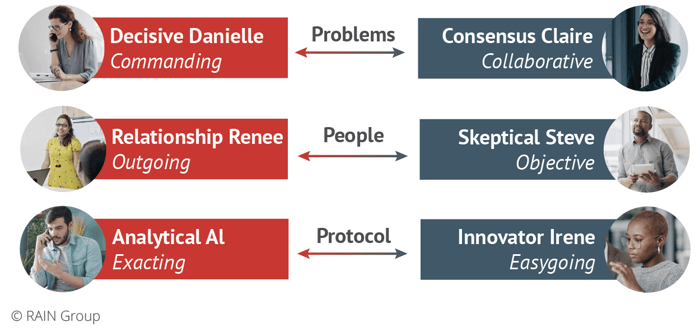
In addition to the set of needs specific to each buyer, buyers have a range of communication preferences and buying styles. If you can identify which applies to your buyers, you can plan your sales activities to match.
Six buyer personas define these preferences, though buyers often display a mix of preferences and buying styles. With these personas as a starting point, you can dig deeper into which your prospects resemble and use that information to help guide your conversations with them.
4. Know Your Offering
One of the biggest challenges of B2B sales is navigating the levels of customization and complexity that come with selling solutions.
A canned pitch won’t cut it. You’ll need to answer buyer questions, mitigate risk, and lead compelling proposal presentations. By anticipating common questions and having deep knowledge of your full suite of offerings, you can open up new possibilities and build confidence with buyers.
5. Build a Strong Sales Funnel
Your sales funnel (and by extent, your sales process) must be constructed to account for the buyer journey. You want to meet buyers when they’re looking to solve a problem or explore new possibilities and align your selling process with their buying process.
Notably, across the sales cycle, no single capability distinguishes the best sellers from others. Top-Performing Sellers outperform across every stage, mastering the key skills necessary for each.
The complexity and number of decision makers involved in B2B sales affects the dynamics of your sales funnel. It takes longer to move from stage to stage, so understanding the status of your buyers and how you can move them along the funnel is a must.
6. Grow Your Accounts
Grab a piece of paper and pen and write down the following:
- Name a current account you believe you should be generating more business with.
- Write down the specific need you see or product or service they should be buying, but aren't. (Even better, talk to a few of your colleagues who have a good vision for how to sell your complete capability set, and ask them to meet with you to brainstorm how to grow the account.)
- Write down ideas for how to reach out to the buyer and start discussions around these needs or product/service areas. Be sure your ideas provide value to your buyers.
If you're serious about sales growth, tap into one of the biggest untapped opportunities in B2B sales and look first to your existing clients.
Of course, this is a simple start. Create a strong strategic account plan and execute it, and you might just find yourself flooded with new business.
Read: 6 Tips to Sell to Existing Accounts
7. Bring Insights to Your Buyers
According to our What Sales Winners Do Differently research, the #1 factor most separating sales winners from the rest—according to the 700 buyers we surveyed—is that sales winners bring new ideas and insights to the table. Doing this helps you drive value for buyers and generate new opportunities in your existing accounts.
Buyers want your ideas and are looking for your insights. You can do so by leading a thorough needs discovery and using this information to explore and communicate the impact you can make on their business.
Download: How to Change the Buyer Conversation with Insight Toolkit
8. Stop, Collaborate, and Listen (and Do a Few Other Things)
According to buyers, sales winners don't just provide new ideas and perspectives.
Buyers strongly agree/agree they choose sellers who:
- Collaborate: 73%
- Persuade buyers they will achieve results: 70%
- Listen: 75%
- Understand needs: 73%
These are also among the factors most separating sales winners from second-place finishers.
When it comes to the top two factors—bringing insights and collaborating with buyers—sales winners sell radically differently than second-place finishers. None of the remaining factors—understanding needs, listening, persuading buyers you'll achieve results—are new, it's simply that winners do a better job of them.
Evaluating your own skills can be a challenge—there’s a notable gap in perception between how sellers perceive their own skills and how buyers pursue them. Taking the time to reassess your sales fundamentals is worthwhile, even for a seasoned seller.
9. Minimize Buyer's Risk
For every 100 times you find advice to "sell the ROI," you might find one piece of advice to minimize the perception of risk for the buyer. Risk plays an important role in a buyer's decision process. Buyers are naturally skeptical, especially given the high price point of many B2B deals.
It's your job to minimize this risk and overcome the hurdles. However, this doesn’t mean avoiding talking about risk entirely. If you bring up risk in your conversations and demonstrate how you can reduce it, you can improve trust with your buyer.
10. Reach High to Decision-Makers
The buzz in B2B sales is that buying committees are growing. While this may be true, we've found that by and large, buying teams have one person who has profound influence over the ultimate decision: The Domino.
Whomever plays the role of Domino should receive special attention from you. See if you can get one-on-one time with them and inspire them with your solution.
Often, the Domino is a senior executive or similar. Because of this, learning how to sell to senior executives and understanding their preferences and buying styles can dramatically increase your odds of winning the sale.
11. Be Proactive
Opportunities are out there. Buyers are making strategic investments more frequently and they're open to switching providers. They want your ideas and they want to talk to you early in the buying process.
Approach buyer conversations with value and provide new insights and ideas, and you can blow away your sales goals. But you must do this proactively. Conversations with buyers aren’t going to fall into your lap.
This is also true for conversations about new opportunities with your current accounts. You must proactively create conversations with your existing accounts if you want to grow them.
12. Manage Your TIME for Maximum Sales Productivity
For the greatest B2B sales success, you need to maximize your time and motivation and get the right things done every day. Begin to track your TIME and where you're spending it. Then make a plan for how you want to be spending it. The sooner you figure out where your time is going, the sooner you can start maximizing the time you spend on what's really important.
13. Develop the B2B Sales Skills You Need to Succeed
The top 3 sales skills possessed by sellers at Top-Performing Sales Organizations are:
- Driving and winning sales opportunities: 68% vs. 50% of The Rest
- Core consultative selling: 65% vs. 41% of The Rest
- Driving account growth: 65% vs. 43% of The Rest
Take the time to focus on improving your fundamental consultative selling skills, put a process in place to win your most important sales opportunities, and seek to proactively drive account growth. Do these three things well and you may find yourself among the Top Performers.
14. Track Your Metrics
Best practices are useful, but metrics provide the critical insight necessary to elevate your sales activities.
The number of sales metrics can be overwhelming, and not all metrics deserve the same amount of attention. Take the time to identify your:
- Lead Measures: Specific activities or behaviors likely to drive desired outcomes
- Lag Measures: The ultimate result of a certain set of actions
Once you know what you want to track, set up mechanisms for tracking. For example, if account growth is a priority, identify how many accounts you’ll reach out to, how many opportunities you expect to create from this effort, and ultimately how much in pipeline and closed sales you expect to generate. Then be sure to track this activity and review it regularly to gauge whether or not you are on track.
Organizational Imperatives for B2B Sales
There are also several organizational factors that play a vital role in enabling B2B sales success. Here are three key imperatives that set top-performing organizations apart:
1.Promote Continuous Learning
Research shows that sales success correlates strongly with three interconnected factors: effective management, regular coaching, and comprehensive training. Sellers thrive when given ongoing support through structured onboarding, skill development, coaching, and continuous reinforcement of best practices.
2. Build a Strategic Enablement Function
Sales/revenue enablement has evolved from a nice-to-have into a strategic imperative. Organizations that achieve the greatest success treat enablement as a long-term change management initiative rather than a short-term fix. This approach emphasizes building an adaptive culture focused on sustainable performance improvement.
Download: The Ultimate Sales Enablement Toolkit
3. Prioritize Value Creation
The most successful sales organizations put value creation at the center of everything they do. Our research shows that 81% of Top-Performing Sales Organizations prioritize driving maximum value for buyers. This focus on value manifests in multiple ways.
Value-Driving Sales Organizations consistently outperform their peers across key areas:
- Superior revenue growth and win rates
- Lower undesired sales turnover
- Stronger sales skills and higher seller motivation
- Maximized pricing and margins
- More effective sales processes and account management
- Greater leadership investment in sales effectiveness
- Stronger customer focus and alignment
Driving B2B Sales Outcomes
The complexity of B2B sales demands both individual seller excellence and organizational commitment to success. To achieve sustainable results:
1. Master the Fundamentals
Develop core capabilities in:
- Building and executing a winning sales process
- Leading compelling sales conversations
- Growing existing accounts strategically
2. Build Organizational Support
Create an environment that enables sales success through:
- Continuous learning and development programs
- Strategic sales enablement
- Value-driven culture and processes
3. Measure and Improve
Track both leading and lagging indicators to:
- Identify areas and priorities for improvement
- Refine your sales approach
- Scale what works across the organization
Organizations that combine strong individual selling capabilities with the right organizational support position themselves to achieve higher win rates, stronger account growth, and better overall sales performance.