





Sales organizations spend millions enabling their sellers. They train them on methodology, messaging, playbooks, tools, and frameworks designed to improve how they engage buyers.
Organizations often assume that once sellers are trained, better execution will follow. Often, it doesn't. The issue usually isn’t the training itself. It’s what happens after training—whether managers reinforce it, coach to it, and help sellers apply it in the field
The missing link? Manager enablement.
Seller enablement alone isn’t enough when sales managers shape execution every day. If managers aren’t equipped to reinforce the behaviors training introduces, even the best enablement initiative fades quickly. What begins as an investment in building capabilities becomes a one-time event.
Frontline managers reinforce priorities, assess seller behaviors, guide deal strategy, and coach sellers through real opportunities. If that bridge is weak, even strong seller enablement won’t deliver full impact.
That’s why Gartner’s finding that just 55% of chief sales officers say their frontline sales managers consistently meet performance expectations is so telling. It points to a gap in how managers are enabled, trained, and supported.
Why Managers Have Such an Outsized Impact
In most B2B sales organizations, managers have an outsized influence on performance. They:
- Shape how consistently sellers apply training
- Determine whether pipeline reviews lead to action
- Affect how effectively teams prepare for buyer conversations, advance deals, and learn from wins and losses
A strong manager can lift the performance of an entire team, while a struggling manager can unintentionally limit the impact of every seller reporting to them.
Sellers are 63% more likely to be a Top Performer when they have an effective manager, regular coaching, and effective training.
Top Performer Prevalence: Sellers Overall vs. Sellers with Strong Manager Support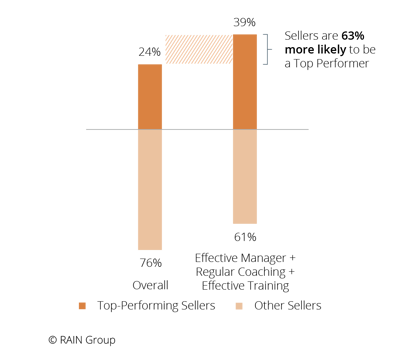
That said, in many organizations, the path to becoming a sales manager is to be a great seller.
Unfortunately, the skills that make someone successful at closing deals aren’t the same as those required to develop people. As a result, high-performing sellers get promoted and suddenly find themselves responsible for coaching, diagnosing performance issues, and developing talent—often with little to no preparation.
This is where organizations often underestimate the challenge of management. They assume managers who know how to sell will naturally know how to coach others to sell. But selling and coaching to sell aren’t the same.
Coaching requires observation, diagnosis, feedback, reinforcement, and accountability. It requires managers to diagnose what’s holding a seller back and help them change their behavior in specific ways. Without guidance, that's hard to do consistently.
Coaching is one of the highest-leverage activities in sales leadership. But in practice, it’s also one of the least structured and supported.
The Gap in Sales Management
One of the biggest barriers to effective sales coaching is lack of visibility.
Traditional coaching often depends on seller self-reporting, occasional observation, or what comes up during deal reviews. That creates an incomplete picture.
Managers are left coaching from anecdotes, assumptions, and lagging indicators instead of repeated, observable practice. They hear what sellers say happened in a conversation, not what actually happened. That’s like trying to coach a sport without ever seeing the game.
This results in uneven feedback, with some sellers receiving strong guidance and others getting little beyond deal review or general advice. Best practices end up staying with top performers instead of spreading across the team.
The Move to Continuous Coaching
Leading revenue teams are moving away from coaching that happens sporadically and toward a more regular, structured coaching.
Using roleplay and coaching tools, both live and AI-driven, managers can create more regularity around how sellers practice, develop, and improve. Instead of relying on rep summaries, occasional shadowing, or sporadic observation, managers gain better visibility into seller readiness, repeated skill patterns, and where coaching can have the greatest impact through technology and other approaches.
Managers can see where sellers are strong, where they struggle, and where reinforcement is needed before those gaps show up in the field. They can move from generic advice like “ask better questions” to targeted coaching grounded in practice, feedback, and real skill development.
Modern manager enablement can be supported in several ways. Depending on the need, organizations may use:
- Structured role-play platforms
- AI-driven practice environments
- Conversation intelligence and coaching tools
- Just-in-time reinforcement tools
- Manager workflow tools that support coaching prep, deal reviews, and skill diagnostics
The point isn't to add technology for its own sake. It's to give managers better visibility, more structure, and more repeatable ways to develop sellers.
One category that can be especially useful is conversation and practice technology.
How Conversation Tools Support Manager Enablement
Used effectively, conversation tools give managers the visibility they’ve been missing. When managers can see patterns in seller behavior earlier, they can intervene sooner and more specifically.
For example, RAIN Group’s AI tool, RAIN Conversation AI, provides realistic AI roleplays, personalized feedback tied to a sales methodology, and visibility into seller strengths, gaps, and progress. Sellers are able to practice real-world conversations on-demand with AI buyers modeled after real customers and prospects, receive instant feedback, and build fluency through repetition. At the same time, managers get clearer signals about where coaching is most needed.
Tools like these:
- Surface coaching opportunities that might otherwise go unnoticed: Managers don’t have unlimited time to observe every seller in every important scenario. A practice environment with scoring and feedback can highlight where sellers need support before counterproductive habits become entrenched.
- Define and reinforce the behaviors top performers use consistently: Instead of treating excellence as instinct or personality, managers can align coaching to the specific behaviors their methodology requires. That helps managers coach with more consistency and gives sellers a clearer picture of what good looks like.
- Make coaching more scalable across teams: One of the biggest barriers to manager effectiveness is span of control. As teams grow, it becomes harder for managers to provide high-quality coaching to every seller. A tool like Conversation AI gives sellers repeatable practice with AI personas and gives managers measurable visibility by individual, team, and scenario, helping make coaching more systematic.
- Reinforce learning over time: Coaching is most effective when it’s ongoing, tied to real work, and connected to measurable improvement. AI role play and coaching help sellers move from knowing to doing, while giving managers clearer coaching signals and enablement leaders better visibility into development priorities.
What This Means for Sales Organizations
A strong sales enablement strategy goes beyond direct seller support. It also equips managers to assess, coach, and reinforce the sales behaviors that drive results.
To strengthen sales performance, organizations need to treat manager enablement as a strategic priority by:
- Building managers’ coaching capability: Clarify what effective coaching looks like, and support managers with tools that provide visibility into readiness, practice quality, and development needs.
- Recognizing that scalable coaching requires both manager capability and system support: Managers need development, and they need better signals.
Seller enablement still matters, but training sellers alone rarely changes performance at scale.
The fortune is in the follow-up to training: performance changes when managers reinforce behaviors, challenge thinking, and help sellers apply new skills in real opportunities.
Top organizations improve sales performance more reliably when they enable managers, not just sellers. Sales managers are the people responsible for helping sellers apply and strengthen new behaviors over time.