




Building an effective sales management team is a challenge for many organizations. Your managers are the backbone of your sales team, responsible for driving execution and ongoing development.
Sales managers are responsible for day-to-day planning and long-term performance management. In this article, we explore the roles necessary for management success and share resources to give managers a roadmap for team leadership.
What Is Sales Management?
Sales management refers to the process of driving sales performance to achieve results. Sales managers are responsible for sales team performance management, pipeline and forecasting, territory planning, sales meeting leadership, and talent management. Sales coaching including motivating sellers, focus and action planning, executing and productivity, advising and facilitating, and skills development is an integral part of sales management.
Learn more about the sales competencies of top sellers. >>
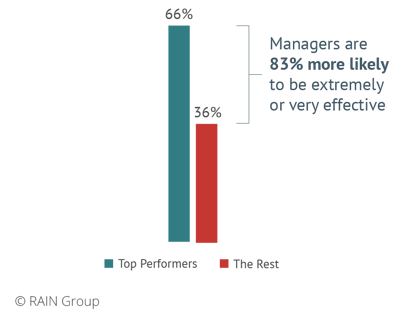
Developing effective sales managers is the objective because, as the research reveals, Top-Performing Sellers are 83% more likely to say their sales managers are effective in supporting their ability to achieve top performance.
Sales Manager Effectiveness According to Sellers
% Extremely/Very Effective
In this post, we break down the sales management roles and highlight areas where Top-Performing Sales Managers do things differently and better than others.
Download the Top-Performing Sales Manager Research Report. >>
The Importance of Sales Management
The role of sales manager has shifted over time, in response to increases in automation and the growing need for continuous learning. Human-centric management is more important than ever.
Managers drive execution daily, but the middle management layer has shrunk in recent years. Though new technologies reduce the need for time spent on tasks such as reporting and analysis, they can’t replace the value of a manager who has cultivated trust and motivation on their team.
The solution is to redefine management, not eliminate it. This new generation of managers should focus on driving growth through seller development, accountability, and strategic guidance.
It’s no coincidence that 59% of top-performing sellers and teams report a regular schedule of coaching conversations with their managers. Consistent coaching is, and will continue to be, a cornerstone of effective management.
In our recent research, we found that 54% of leaders reported “improve sales manager effectiveness” as a very important priority. This comports with broader challenges in execution; organizations are finding that healthy pipelines aren’t translating to results.
When managers have a grasp on organizational methodology and an ongoing understanding of seller capabilities, they can adjust their coaching accordingly. In addition, as orgs invest in enablement to upskill sellers, managers are necessary to reinforce new behaviors, apply skills, and identify development needs.
This is why manager enablement is a critical part of performance improvement. Enablement initiatives may provide the initial spark for seller change, but it’s managers who solidify it.
What's the Difference Between Sales Coaching and Sales Management?
Sales managers play two different types of roles: coaching and managing. What’s the difference between a “coaching” role and a “management” role?
Sales Coaching is done, and can only be done, directly with sellers. It’s a two-way interaction that happens collaboratively. Coaching topics are the shared responsibility of the seller and manager.
For example, the sales manager is the linchpin in making sure motivation and productivity happen systematically across the sales team. Though the seller is ultimately responsible for their own productivity, the sales coach must create an environment that promotes productivity and provides the tools for sellers to sustain productivity and motivation over an extended period.
Sales Management is the area where managers organize, execute, and monitor structurally to drive performance. Sellers affect managers’ vision, decision-making, and actions in these areas, but management topics are primarily the responsibility of the manager.
The coaching and management roles work together synergistically. Sales managers have to wear both manager and coach hats and play the roles in each area well if they want their teams to achieve top performance.
Let’s take a closer look at the specific roles and the competency model that serves as a roadmap to developing sales managers’ capabilities.
A Roadmap for Sales Managers
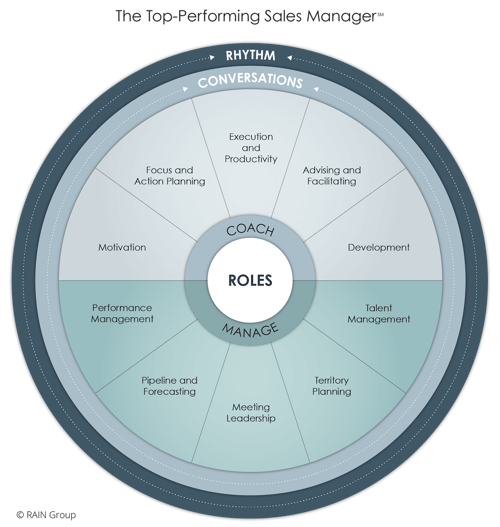
When people see this model for the first time, most say it’s helpful just to see it all in one visual. But other people say, “Isn’t this a lot for someone to be good at to succeed as a sales manager?”
But think about it this way:
To be a great seller, you have to know your offerings inside and out, know how you solve problems for others and the results you’ve achieved, lead great needs discoveries, learn to craft solutions, present persuasively, negotiate, win deals, manage opportunities and outsell the competition, prospect and build pipeline, lead masterful sales conversations of different types, grow accounts, and more.
The point is: being a great sales manager doesn’t mean you need to learn more than sellers do, rather you need to learn a different set of capabilities as a sales manager.
RAIN Group’s Top-Performing Sales Manager model is the guide to get you there.
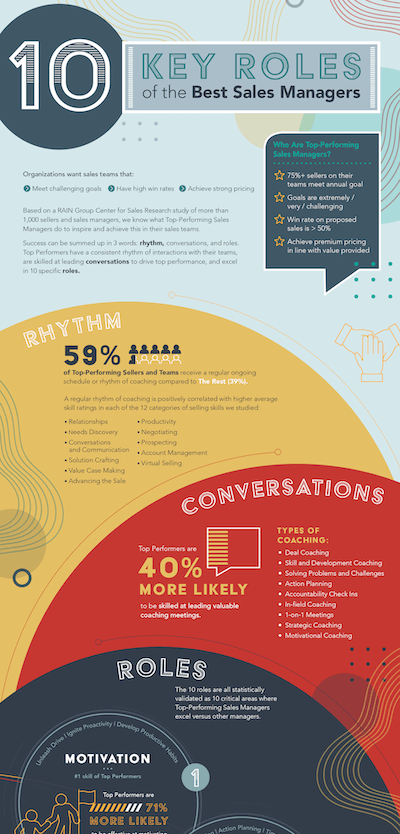
In this infographic, we reveal the three pillars of sales management success and dive deeper into the 10 roles sales managers must play to inspire their sellers and drive top performance on their teams. Read on for a more thorough analysis on how each of these roles contributes to management success.
Click the infographic to enlarge.
5 Coaching-Related Roles of Sales Managers
In the Top-Performing Sales Manager model, five coaching-related roles form the crux of everything sales managers need to do to become great sales coaches.
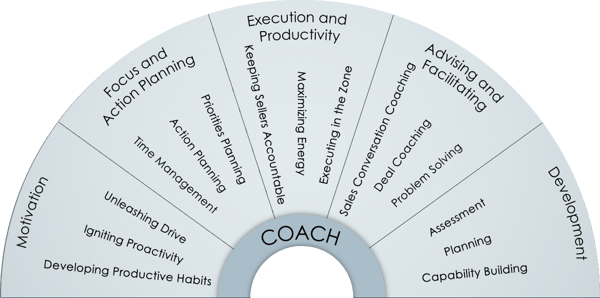
The 5 coaching-related roles are:
- Motivation
- Focus and Action Planning
- Execution and Productivity
- Advising and Facilitating
- Development
We’ll touch on each of those in a moment, but it’s important to note at the outset that, at a high level, you should think of them simply like this: if you have a motivated team focused on the right activities that's productive as they work, you’ll be well-positioned to have a top-performing team.
If you can give sellers advice on how to succeed at whatever they’re working on—for example, on winning major sales, driving account growth, planning a sales conversation, building their pipelines, and so on—you’ll help them win sales and drive results daily.
And, finally, if you take the lead on developing your team to be better sellers over time, your team’s performance will rise over time.
Do well in all five coaching-related roles, and it’s almost impossible not to succeed.
The magic, of course, is in how you get there.
1. Motivation
This is the #1 skill of Top-Performing Sales Managers. Sales managers must unleash the motivation within each seller on their teams to maximize seller energy, effort, and success outlook.
Many people believe that someone is either motivated and driven—or not. What’s fascinating about motivation is that much research has shown it’s less like an attribute that defines you (or doesn’t), and more like a skill you learn.
In fact, at RAIN Group, we’ve learned that even if a seller isn’t feeling motivated, by teaching them strategies and tactics to become motivated, sales managers can literally help sellers manufacture motivation and build it like a muscle that gets stronger and stronger over time.
The 3 key components of motivation are helping sellers:
- Unleash their drive
- Ignite their proactivity
- Develop productive habits that help them succeed, thereby reinforcing overall motivation and positive attitude
2. Focus and Action Planning
Sales managers help sellers define what they need to achieve in any given period—such as a quarter or a month—plan their weekly actions and accountabilities to get those actions done, and manage their time so they stay focused on what’s important and don’t get distracted by what isn’t.
Top-Performing Sales Managers are 41% more likely to excel at helping sellers build meaningful goal and action plans.
3. Execution and Productivity
Sales managers guide sellers to get the greatest production from every hour they work. This means helping sellers execute in the zone, or achieve flow, where work output is 5x higher than when not in the zone, according to research by McKinsey & Company.
It also means helping sellers maximize their energy so they can focus for the greatest period of time and feel good as they do it—and help them get back on track when they get derailed.
As mentioned earlier, Top-Performing Sellers are significantly more likely to be highly rated across all major productivity areas. Furthermore, Top-Performing Sales Managers are 71% more likely to be effective at motivating sellers for high productivity and performance.
4. Advising and Facilitating
Sales managers help sellers win deals, drive account growth, and solve problems that are hindering their success. For example, Top-Performing Sales Managers are more likely to excel at coaching sellers to:
- Lead great sales conversations (52%)
- Win sales opportunities (45%)
- Grow accounts (47%)
- Fill the pipeline (30%)
It’s important to reinforce that this isn’t just Advising, it’s also Facilitating. Helping sellers arrive at their own answers by asking questions and coaching them also enables them to take greater psychological ownership of the solution. If you want to teach sellers, and improve accountability for action, facilitating instead of telling is key.
5. Development
Development is the #1 key driver of sales manager effectiveness. Sales managers need to:
- Assess the areas where sellers can improve
- Create plans to help them develop the skills, knowledge, and habits they need to improve
- Help to develop those seller capabilities
Again, this requires facilitating instead of simply telling them how to do it.
Get a Sales Coaching Plan + Checklist. >>
After considering these five coaching-related roles of sales managers, many people tell us two things:
- “If you can do well in all five of these roles, sales team success will be virtually assured.”
- “I’m good in some areas but not as much in others, so there’s a lot to learn.”
This is where an effective sales training and enablement initiative comes in. It gives sales managers the knowledge, skills, and tools they can use to motivate their teams, hold them accountable, and coach them to top performance.
5 Management-Related Roles of Sales Managers
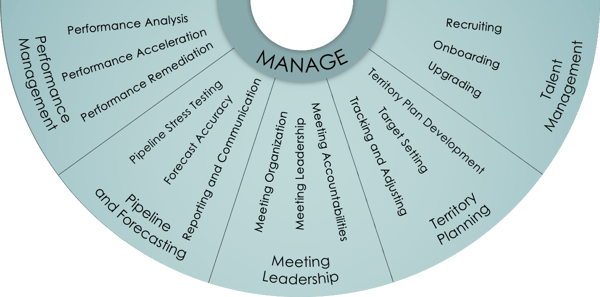
The 5 management-related roles of the sales manager are:
- Performance Management
- Pipeline and Forecasting
- Meeting Leadership
- Territory Planning
- Talent Management
1. Performance Management
As mentioned above, we know that Top-Performing Sellers are 83% more likely to report their managers are very or extremely effective at helping them achieve strong performance. This is central to the sales manager role.
Performance Management includes three core areas:
- Performance analysis, where sales managers figure out, for their sellers and their team, progress against the plan, including what’s working and what’s not
- Performance acceleration, which focuses on helping sellers get to the next level of performance, whatever that is for each person
- Performance remediation, which focuses on turning around sellers who are falling behind, or finding a way to help them gracefully exit the role
2. Pipeline and Forecasting
Sales managers must also help sellers build and manage pipeline and forecast results for themselves and their sellers. Both to stay on the path to outperforming their goals, as well as to share with senior management.
Top-Performing Sales Managers are 52% more likely to excel at planning and analyzing how sellers should manage their pipelines.
Pipeline and Forecasting focuses on three areas:
- Pipeline stress testing, where sales managers separate truth from the fiction of what’s really happening in seller pipelines, and how strong—or not strong—they are
- Forecast accuracy, focusing on being the best guesser of what will actually come out of the pipeline as wins and for how much money
- Reporting and communication, which is focused on just that: sharing clear and defensible information on the strength of team pipeline
3. Meeting Leadership
In the Harvard Business Review, business guru Peter Drucker famously outlined eight areas where effective leaders excelled. One of them was that they ran productive meetings. The same is true for sales managers. Top-Performing Sales Managers are 42% more likely to excel at leading valuable sales meetings.
Meeting Leadership includes: meeting organization and agenda setting, leading and facilitating meetings successfully, and holding people accountable for commitments made at meetings.
4. Territory Planning
Territory Planning is an often-misunderstood role of a sales manager, sometimes because of the name. The name “Territory Planning” seems to suggest assigning sellers a geography, but that’s really not it.
Territory Planning is about creating a solid, defensible plan for a seller to achieve their sales target. This might focus on geography, but it could also be defined by industry, account types, offering areas, or something else.
In any case, Top Performers are 52% more likely to excel at planning and analyzing how sellers should manage their territories in order to achieve their sales goals.
Territory Planning includes three areas:
- Territory plan development
- Target setting, both for overall targets and interim targets, and milestones that are lead indicators of success
- Tracking and adjusting, making sure that plans stay actionable and relevant, and get updated as conditions change
5. Talent Management
Finally, sales managers need the right people on their teams in order to succeed. Indeed, Top Performers are 42% more likely to excel at hiring sellers who become top performers.
Talent Management includes recruiting sellers to your team, onboarding sellers successfully, and upgrading the team when it becomes clear that a seller is unlikely to succeed.
Again, as mentioned earlier, it may seem that sales managers must excel at a lot to achieve top performance, but it bears repeating that sales managers need to master a different set of capabilities compared to sellers.
Sales Management Tools
All sales managers need to keep track of a large volume of information to do their jobs well. Simplify your responsibilities with our selection of sales management tools.
Turnover Calculator
When hiring goes wrong, it’s a major cost for your organization. Even when a candidate is a good fit for a position, it takes months until they’re full-fledged contributors. Use this turnover calculator to calculate the cost of new seller turnover for your organization. Read on for more on how to implement an effective onboarding process for new sellers.
Toolkit: The Essential Guide to Sales Territory Planning
When done well, territory planning aligns sellers to the right targets and sets actionable next steps to hit them. This complimentary toolkit gives you a roadmap to effective territory planning, including how to set smart targets, track key metrics, and adjust along the way.
Sales Recruitment Toolkit: How to Hire the Right Salespeople
Identify top sales talent and convince candidates to accept your offers. Go into hiring with a plan with the help of this toolkit on screening, interviewing, and retaining strong sellers.
Sales Management Course
Help your sales managers drive and inspire top sales performance. Our comprehensive sales management curriculum is built around the Top-Performing Sales Manager model, teaching your managers to deliver a regular rhythm of coaching, play the 10 sales management and coaching roles, and lead masterful sales management and coaching conversations.
Checklist: How to Choose a Sales Training Provider
Sales training is a commitment, and not one sales managers should take lightly. Sales leaders are responsible for finding a sales training provider that will drive desired results for an organization. This checklist provides a list of criteria to consider when planning your next training initiative.
The Sales Forecasting Toolkit
Can you predict your revenue for next month? How about next year? When sales managers can't produce defensible numbers in their sales forecasts, organizational planning becomes much more difficult. This toolkit provides resources to help you apply rigor to your sales forecasting and pipeline management processes.
How to Build a Sales Coaching Plan
While sales coaching is an important piece of the management puzzle, it’s challenging to figure out where to start. This collection of resources gives you a practical guide to uncover opportunities for growth and implement a consistent and engaging sales coaching plan.
A Roadmap to Crafting a Sales Management and Coaching Curriculum for Top Performance
At RAIN Group, we help our clients identify the capabilities and gaps in their sales management teams using the research-validated Top-Performing Sales Manager model as a guide. We design focused and relevant curricula so sales training initiatives will be highly effective, resulting in lasting behavior change and generating desired results.
 The Top-Performing Sales Manager Model in Action
Your organization can use The Top-Performing Sales Manager model as you craft your sales management and coaching training curriculum. For more help, contact us or learn more about how RAIN Sales Management can help you build an elite team of managers.