




Sales Training Defined
Sales training is the process of improving seller capabilities to drive behavior change and maximize sales success. Effective sales training should be viewed, designed, and executed as a change management initiative.
Done right, sales training can help organizations achieve their growth goals: increasing win rates, growing strategic accounts, improving sales cycle time, building pipeline, increasing average deal size, and more.
The global market for sales training is approximately $4.6 billion, yet most sales training fails to deliver lasting results.
This is because most companies don't define and approach sales training properly. Often, training is treated as a 1- or 2-day program with no follow-up. Sellers are left to their own devices, expected to retain the information from these often jam-packed sessions and recognize where to apply it.
When you consider that 70% of B2B sales reps forget the information they learn within a week of training, it's no wonder most sales training doesn't produce the desired results over the long term.
The most effective sales training focuses on true behavior change. Skills need to be learned, absorbed, and applied on the job.
Successful sales training initiatives focus on changing sellers' behavior to drive sales results and support the effort as an ongoing change management process.
There’s no such thing as one-size-fits-all training—but there are some key factors high-impact programs tend to share. Read on to learn what effective sales training programs look like, how they can impact your team, and how to choose the best sales training provider for your needs.
Your Guide to Sales Training
- What Are the Different Types of Sales Training?
- Sales Training Components
- What Are the Benefits of Sales Training?
- Who Is Sales Training For?
- What Are the Skills You Can Teach with Sales Training?
- Sales Training Success Metrics
- Common Sales Training Challenges
- Finding the Best Sales Training Program
- Sales Training That Drives Results
What Are the Different Types of Sales Training?
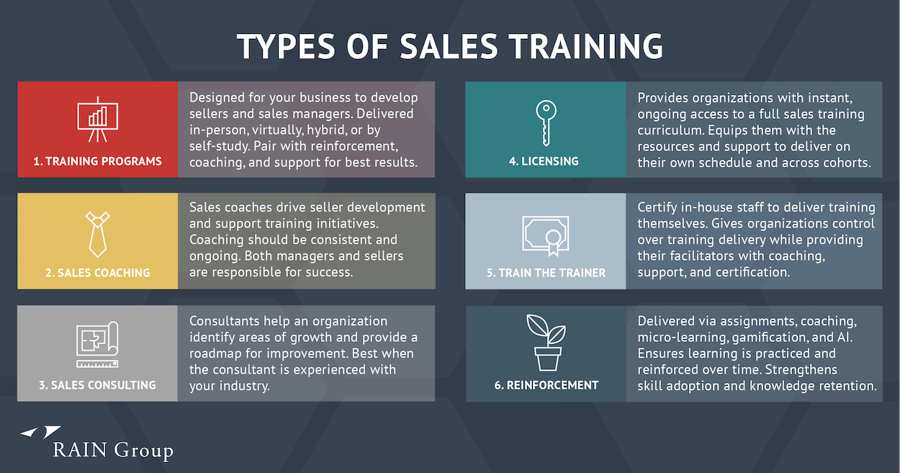
1. Sales Training Programs
Training programs are designed to develop competencies of sellers and sales managers. The most effective sales training programs are more than one-hit wonders: they provide the ongoing support teams need to create lasting behavior change. The best programs align with the organization’s key business metrics to ensure goals are met and measurable improvement is achieved.
Sales training programs are available in a variety of areas, including consultative selling, prospecting, negotiating, strategic and key account management, sales management, and personal productivity.
2. Sales Coaching
One of the best ways to make sure training sticks and is applied in actual selling situations is through sales coaching. Coaching can help sellers improve skills, win specific sales opportunities, grow accounts, achieve sales goals, and accomplish action plans.
But too often this critical component is skipped, frequently after a significant investment in training has already been made. Everyone—individual sellers, entire sales teams, and organizations—pays the price.
As our research shows, sellers are 63% more likely to be a Top Performer when they have:
- An effective sales manager
- Regular, ongoing sales coaching
- Effective sales training
Take any one of these away, and the likelihood of achieving top sales performance declines.
Meanwhile, an effective sales coaching process helps teams build skills, reinforces what they learn, and holds them accountable to goals and plans.
3. Sales Consulting
Your leadership team likely has plenty of ideas about what could be done to improve sales. But with competing priorities around people, structure, process, compensation, management, and training, it’s difficult to know where to begin and what to prioritize.
An experienced sales consulting partner can offer expert insight and analysis to help organizations identify the greatest opportunities for revenue growth. Moreover, they can provide a roadmap with specific next steps and a complete sequence of actions to ensure organizations achieve their potential.
4. Licensing
A license that gives your entire sales team access to an innovative and comprehensive sales curriculum can help you get the greatest results from your training investment.
For example, at RAIN Group, we offer clients the opportunity to embed our complete educational system into their sales organization. The RAIN Group Total Access license gives your team access to our complete suite of sales training programs, online learning, performance support tools, learning journeys, and other resources.
5. Train the Trainer
One of the most important factors for a successful training initiative is facilitation quality. Success hinges on the trainer’s ability to not only fully engage participants, but also gain their confidence and be seen as an expert guide.
A train the trainer process allows organizations to have their own facilitators trained to deliver sales training programs. RAIN Group’s Train the Trainer process, for example, can certify an organization’s trainers to implement our sales methodology for their sales team. This gives the organization more flexibility and control over program delivery while giving in-house trainers the coaching, support, and certification to effectively guide teams, drive change, and achieve goals.
6. Reinforcement
For all types of sales training, bespoke reinforcement is necessary to ensure sellers retain and apply new skills. Reinforcement can be delivered in a variety of ways, such as:
- Assignments
- Coaching
- Gamification
- Micro-learning
- AI tools
Whatever the method, reinforcement should be designed to create new habits and help sellers integrate skills into their selling processes. In addition, for reinforcement to be effective, results should be rigorously tracked. Ongoing monitoring and follow-up gives structure to training reinforcement and allows you to benchmark your team's progress toward its goals.
The impact of reinforcement can't be understated: if not reinforced, 77% of learning is forgotten within 6 days.
Sales Training Components
- Skill Development: Sales training programs should include a curriculum built around the specific areas in which your sellers need improvement. Focus is key: training should be guided by assessment.
- Customization: Training should be tailored to the organization. Industry, sales methodology, strategy, and culture are all factors that influence how training should be customized.
- Learning Experience: For sales training to drive real behavior change, it needs to engage with adult learners and resonate with them. Elements of a strong learning experience include accessibility, interactivity, technology integration, and role-based personalization.
- Practice and Application: Bridging the gap between learning and doing is one of the biggest challenges in sales training. Build sellers’ experience and confidence through simulated sales conversations and roleplays, gamification, and immediate feedback.
- Structured Reinforcement: Whether supported by coaches or with peers, sales training needs a follow-up plan to succeed. Regular coaching, personalized action plans, and reinforcement workshops can all contribute to long-term results.
- Ongoing Measurement: Define how training success will be measured, align metrics with your strategic goals, and track progress consistently. Measurement illustrates training ROI and informs future development initiatives.
What Are the Benefits of Sales Training?
Effective sales training changes sellers’ behavior and improves business results.
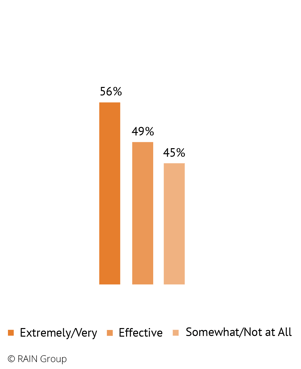
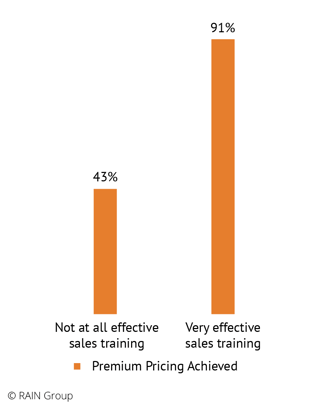
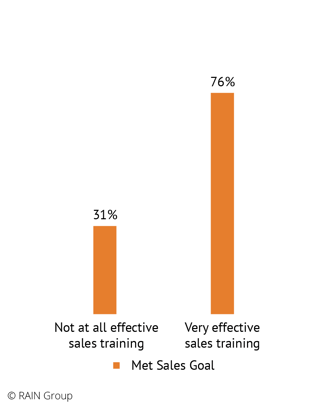
In fact, our research shows highly effective sales training is correlated with three key metrics: win rate, sales goal attainment, and premium pricing:
- Respondents with extremely/very effective sales training report average win rates that are 7 to 11 points higher than those who report having received less effective training
- 76% of respondents with extremely effective sales training met their sales goal compared to only 31% of those with the least effective training
- 91% of respondents with extremely effective sales training achieved premium pricing compared to just 43% of those with the least effective training
| Average Win Rate by Sales Training Effectiveness |
Training Effectiveness & Sales Goal Status |
Training Effectiveness & Premium Pricing |
 |
 |
 |
| Source: RAIN Group Center for Sales Research, The Top-Performing Seller. | ||
The best sales training can result in both strategic and financial benefits for the organization, enabling teams to:
- Increase win rate on proposed business
- Increase average size of sale
- Achieve premium pricing
- Improve sales margins
- Grow existing accounts
- Win more business with new accounts
- Build a culture of sales achievement
- Increase effectiveness of sales leadership and management
- ...and much more
But to achieve these outcomes, organizations must approach training with their business goals in mind and work with their training provider or internal training and enablement teams to determine how to most effectively pursue those goals.
The actual outcomes should be specific to the organization, but below are examples of some common benefits organizations can achieve from effective sales training initiatives. Use a framework like this one to reflect on the current state of your sales training and how you can bring about a new reality with an effective sales training initiative.
|
EFFECTIVE SALES TRAINING BENEFITS What’s the current state of your organization’s sales training? |
|
|
Current State |
New Reality |
|
Current training initiatives fail to change the status quo and achieve results |
Effective training is delivered by a training partner, driving change and delivering results. |
|
Sellers spend too much time out of the field at an excessive travel cost to attend ineffective training |
Effective sales training minimizes time of out of field by using an approach that combines in-person and virtual instructor-led training, along with additional modalities. |
|
Training doesn’t develop your sellers’ skillset. |
A competency-based approach to training includes certification and is easily tailored to your organization’s and sellers’ needs. |
|
Training is boring and generic. |
Training is engaging and easily tailored to be directly relevant to selling situations. |
|
Sellers struggle with sales conversations across the board and struggle to provide maximum value to buyers. |
Sales conversation training raises the bar on sales conversation success. Sellers can inspire buyers, tell stories, and sell ideas in a compelling way. Across the board, sellers build, communicate, and sell value consistently. |
|
Sales managers do not inspire top performance from their sellers. |
Effective sales management and coaching training helps managers maximize their sales team’s motivation, focus, and results. Managers regularly coach sellers to drive significant wins and consistent account growth. |
|
Training consists of a jumbled mix of methods or confusing programs. |
Effective sales training ensures a durable method is embedded in the organization and results are achieved. |
These are just a few examples. Ask yourself, "What’s the current state of our organization’s sales training?". Then, consider what the new reality would look like with an effective sales training initiative. An experienced sales consultant is a valuable resource here; they can help you do this analysis and develop the blueprint that will get you to your desired results.
Want to learn how RAIN Group has helped organizations achieve sales results? Read our client success stories. >>
Who Is Sales Training For?
Sales training isn’t just for sellers. Where capability gaps exist, skills must be developed for all sales professionals and sales managers in an organization.
1. Sales Professionals
With titles such as sales rep, inside sales, field sales, business development rep (BDR), account manager, account or sales executive, customer service rep (CSR), seller-doer, professional or business service provider, and more, these frontline sales professionals are responsible for some or all aspects of working with buyers in the sales cycle.
These team members must develop and maintain a high level of capability in a variety of areas, depending on the role. These could include sales conversations, advanced consultative selling, winning major sales, strategic and key account management, sales prospecting, sales negotiating, virtual selling, and personal productivity. Learn more. >>
2. Sales Managers
Managing a sales team is one of the most important and challenging roles in any company. Your sales managers will make or break your sales team.
The manager’s impact is especially strong when it comes to newer sellers. According to our research, newer sellers are 240% more likely to be Top Performers when they have an effective manager. And those sales managers are 46% more likely to be effective when they themselves have received effective training.
|
240% Sellers with fewer than 5 years' experience are 240% more likely to be Top-Performing Sellers when they have an effective sales manager. |
71% Top Performers are 71% more likely to have a manager who excels at motivating for high productivity and performance. |
46% Top-Performing Sales Managers are 46% more likely to receive extremely/very effective training. |
Source: The Top-Performing Sales Manager Benchmark Report, RAIN Group Center for Sales Research
|
240% Sellers with less than 5 years' experience are 240% more likely to be a Top-Performing Seller when they have an effective sales manager. |
|
71% Top Performers are 71% more likely to have a manager who excels at motivating for high productivity and performance. |
|
46% Top-Performing Sales Managers are 46% more likely to receive extremely/very effective training. |
Source: The Top-Performing Sales Manager Benchmark Report, RAIN Group Center for Sales Research
Too many managers, however, don’t get the support they need to be successful in the role. This group frequently includes high-performing sellers who find themselves promoted to manager and are expected to immediately excel at managing in the same way they did at selling. Yet, the two roles require different skill sets, with dedicate training to match.
Sales managers must excel in a variety of areas, such as knowing how to lead successful team and one-on-one meetings; coaching sellers to build skills and motivating them to consistently achieve sales targets, forecasting, and interviewing and hiring sellers who will become top performers.
Providing an effective sales management training program gives sales leaders the knowledge, skills, and tools they need to motivate sellers, hold them accountable, and coach them to top performance.
What Skills Can You Teach with Sales Training?
Sales training can be focused on specific selling topics or skills development. Today's leading sales training programs cover the spectrum of the sales process, from finding new clients and winning sales opportunities, to growing accounts and managing sellers.
Sales training topics that are core to maximizing success and improvement in sales skill mastery include:
1. Fundamentals of Consultative Selling
Consultative selling is a sales approach centered around understanding buyer needs and positioning offers as solutions to problems. Though the utility of consultative selling has changed over time, it remains fundamental to uncovering needs, building relationships, and crafting solutions.
Modern consultative selling takes this idea a step further by inspiring buyers with new ideas and changing their thinking and agendas in critical areas. This method of advanced consultative selling is known as insight selling.
2. Prospecting & Filling the Pipeline
Sales prospecting training gives sellers a roadmap to improve their outreach and connect with buyers early and often, so they can maintain an active pipeline of buyers. Training covers how to create prospecting campaigns, craft offers, break through to buyers, set meetings, and more.
3. The Keys of Sales Negotiation
Negotiation is critical for sellers to keep margins, customer profitability, and satisfaction high. Training aims to coach sellers to focus on value over price and create value on both sides. It also addresses common negotiation tactics used by buyers and how to overcome them.
4. Winning More Opportunities
Strong selling is the result of a comprehensive sales strategy. Opportunity management training helps teams establish a systematic and repeatable process for creating winning strategies. It also encourages sales teams to approach each sale from a customer-centric point of view.
5. Growing Strategic and Key Accounts
Selling to existing accounts is one of the biggest untapped opportunities for revenue growth. Strategic and key account management training helps sellers systematically review and grow their most important accounts.
6. Succeeding with Virtual Selling
With the unprecedented level of virtual interaction happening in the world today, sellers face more challenges than ever before. Modern sales teams need to be prepared for both in-person and virtual selling to succeed. Virtual selling training helps sellers adapt and thrive in this new sales environment.
7. Improved Sales Productivity and Accountability
Mismanaged time doesn’t just derail focus and productivity—it affects your sales results. Keeping your sellers motivated is essential to seeing consistent success. Most sales training misses this key element: a sales-focused productivity program that empowers sellers to get more done in the time they have.
8. Sales Management
The skills that make a successful seller are very different than those that make a successful sales manager. In fact, managing a sales team is one of the most difficult jobs in any organization. Sales management training helps managers unlock their team’s potential and drive results.
9. Sales Coaching
There is perhaps no greater leverage point to increase sales performance than sales coaching. Yet, 66% of organizations don’t believe their managers have the skills needed to manage and coach their sellers. Sales coaching training gives sales managers the tools they need to motivate their sellers to become more proactive and successful.
Sales Training Success Metrics
Your sales training provider should work with you to identify what your sales training goals are and how these goals will be achieved, as well as determining how success will be measured. If your current provider isn’t doing this, it may be time to search for a new one.
Key performance indicators (KPIs), identified at the outset of a training initiative, are used as measures of success. Common examples of KPIs, which will vary based on your objectives, may include any of the following:
Lead Measures
- Weighted average pipeline size
- Pipeline growth
- Sales activity (e.g., outbound activity, meetings)
- Sales productivity (e.g., time spent selling)
- Sales method and process adoption
- Deal reviews (Win Labs) conducted
- Sales skill progress/certification
- Satisfaction with training
- Seller engagement
- Seller action plan clarity
Lag Measures
- Win rate on proposed sales
- Average sale/order value
- Time to productivity
- Percent attainment of sales goal
- Discounting/profitability of sales
- Average account revenue
- Average revenue per seller
- Repeat business rate/churn
- Length of sales cycle
- Sales force turnover rate
Discover additional sales metrics that may be relevant for your business in our Essential List of Sales Metrics.
Common Sales Training Challenges
- Unclear direction: Your sales training initiatives should be tailored to your organization, industry, methodology, and seller capabilities. If you don’t assess your team’s needs and design training with clear objectives, it won’t lead to lasting results.
- Difficulty driving application: If you can’t bridge the gap between training and application, you won’t justify the investment. Sales training shouldn’t simply transfer knowledge; it should equip sellers with actionable steps they can use on the job.
- Lack of engagement: Without structures in place to keep sellers engaged, training will fall flat. Incorporate interactive elements, gain learner commitment, and hold sellers accountable.
- Lack of reinforcement: Sales training isn’t a fire-and-forget solution. It needs ongoing coaching and reinforcement to create lasting behavior change.
- Failure to track progress: If you’re not measuring your sales training outcomes, you won’t be able to demonstrate ROI. Choosing the right metrics and tracking them consistently is essential to improve training over time and prove its impact.
The Best Sales Training Programs
By this point, you likely realize the heavy lift that sales leaders, learning and development, and sales enablement professionals face as they embark on selecting a sales trainer or sales training provider to deliver effective sales training that gets results.
Here are 13 factors to consider and evaluate when you’re hiring a sales training provider.
1. Transformational Experience
The best and most effective sales training is approached as a change management initiative. Training is crafted, delivered, and designed to enable sellers and the organization to get results. For true behavior change to take hold, sellers need to go through a transformational experience. This means the training provider must understand how adults learn, how people work (and work together), and how behaviors change.
RAIN Group’s Execution Assurance framework ensures this transformational experience: sellers adopt and apply what they learn, and clients get results from sales training.
2. Coaching
Coaching and support from first-line sales managers is critical for driving behavior change. When applying new skills, sellers need to know exactly what to do, have support for when they're not in their comfort zone, be able to access feedback to calibrate their behaviors, and be held accountable for taking action and being productive.
It’s worth noting that sales coaching and sales management differ. Coaching is a proactive process meant to reinforce training, and not every sales leader or manager has that experience. In these cases, specialized sales coaching training can enable managers to take ownership of the skill development of their teams.
Does the sales training provider offer a coaching process that enables sales managers to support their sales teams?
RAIN Group offers a coaching process designed to help organizations build a team of top performers. Coaching helps develop the team’s skills, reinforce training, and hold sellers accountable to achieve goals.
3. Leadership Support
Conversely, sellers also need support on the day-to-day side of executing ideas learned in training. Leadership should be committed to working with the training provider and the sales training program to help execute training, as well as monitor its application.
You need a work culture that drives and supports top sales performance and leadership that prioritizes sales success.
Are you confident the sales training provider can garner buy-in and support from your leadership?
RAIN Group actively engages with leadership during all phases of a training initiative, but especially during the initial crafting phase to ensure clarity, alignment, and a program perfectly suited to the organization.
4. Motivation
Without motivation, you won't change sellers' behaviors. It’s why "motivator" is one of the key coaching roles played by sales managers. In fact, our research finds that Top-Performing Sales Managers are 71% more likely to be effective at motivating sellers for high productivity and performance. Yes, sales motivation goes beyond compensation.
Does the training provider explicitly build this critical success factor into their training?
RAIN Group has training modules that focus explicitly on motivation. For sellers, it’s a core part of sales productivity and personal effectiveness training. For sales managers, it’s one the 10 key roles we train for when developing top-performing sales managers.
5. Value
When sellers create value and are valuable to buyers, they win. All sales training must connect to the value you can bring to your buyers. For the most successful sales training, and to achieve and maintain top performance, value must be the core focus.
How will this training help your sellers drive more customer value?
At RAIN Group, value is central to all sales training. Seller training revolves around developing sellers’ skillsets so they can deliver value to their customers.
6. Proven Results and Case Studies
Sales training companies have a mixed record of implementation and client service.
Has the training provider demonstrated experience and results in changing seller behavior and making training stick long-term?
RAIN Group focuses heavily on excellence in these areas and has proven its ability to drive results for its clients. As an industry leader, RAIN Group has also been recognized by Selling Power and Training Industries (Top 20 Sales Companies lists), the Stevie Awards (Sales Training Practice of the Year and Sales Trainer of the Year), among others.
7. Industry Expertise
Sales trainers lacking experience in the sellers’ industry lose credibility with learners. Without industry experience, trainers will be hard-pressed to keep sellers engaged and involved with the training. Make sure the training provider understands your industry deeply—its challenges, business model, current issues and changes, and selling environment.
What experience does the sales training provider have in your industry?
RAIN Group has celebrated its 20th year of providing training services to clients in banking and financial services, technology, manufacturing, business and professional services, life sciences, and other B2B complex sales spaces.
8. Research-Based Training
By its nature, sales isn’t static. To be successful, sellers must be responsive to their buyers’ current environment and adapt to market changes as needed. It’s not enough for trainers to simply roll out a dated playbook to deliver sales training content.
Sales training providers that conduct their own research can share relevant insights and strategies for succeeding with buyers based on current, and anticipated, conditions.
What research backs the training providers’ sales methods?
RAIN Group’s Center for Sales Research conducts primary research to keep a finger on the pulse of what’s working and what’s not in sales today. Clients benefit from direct access to research and research-validated training for skills development, top performance, buyer perceptions, sales challenges, and more.
9. Variety of Delivery Methods
According to research from Gartner, sellers forget 70% of the information they learn within a week of training; 87% forget it within a month. But when sellers are introduced to information over time using multimedia, 80% of the information is retained and learning improves.
Does your provider deliver training exclusively through one channel? For example, in-person classroom sessions alone? If so, sellers are less likely to retain what they learn. Look for a provider that delivers multi-modal training to boost retention and application.
Typical training modalities include:
- Instructor-led training (onsite and virtual)
- E-learning (online, asynchronous)
- Mobile and email
- Video and micro learning
- Simulations
- Gamification
- Coaching
RAIN Group delivers training using a blend of modalities. Instructor-led virtual sessions, as well as in-person sessions, are highly interactive and discussion-based. Video, mobile, and email channels are used for pre-work and reinforcement. Application assignments and coaching help sellers know when, where, and how to apply the skills they’ve learned. When paired with our coaching process, the training sticks, is applied, and gets results.
10. Breadth and Flexibility of Offerings
Sellers have a variety of skill development needs based on their roles, gaps in existing capabilities, and the organization’s needs.
Does the training provider offer training in the specific and focused areas your sellers need?
RAIN Group takes a modular approach to curriculum development, which means we can quickly customize training curricula to meet the specific needs of sellers and organizations. Our comprehensive library includes portable modular blocks of training that align to provide sales training that sticks, changes behavior, and gets results.
11. Customized Training
It’s no secret that sales training that’s tailored to an organization’s industry, market, offerings, and selling situations will be more engaging to sellers. When knowledge and insights are directly relevant to their real-life selling experiences, sellers will be more likely to retain and use what they learn. Customized examples, templates, planners, and so on will prove useful in the course of their work. Skills learned will be adopted and used because they actually help sellers get results.
Does the training provider you’re considering support and encourage customization?
RAIN Group believes partnership is the best path to success. We’re able to customize and tailor sales training across a wide range of areas, from content contextualization, to delivery and execution assurance process.
12. Sales Enablement Technology
Does the training provider offer a robust sales enablement platform that’s:
- Easy to use
- Optimized for sellers
- Provides easy-to-access resources for sellers (e.g., tools, templates, planners, checklists)
- Offers practice, reinforcement, and reporting?
RAIN Group’s enablement platform, Catalyst, centralizes learning experiences, coaching systems, and AI tools to provide guidance, insight, and measurement at scale.
13. Global Capabilities
Sales organizations span the globe. Is the training provider experienced and equipped to meet the challenges of crafting, delivering, and enabling sales training across the globe with attention to language, culture, and more?
RAIN Group’s global capabilities include: 11 global offices, delivery in multiple languages, materials translation support as needed, experience delivering sales training in 90 countries, and ongoing success with global, large-scale roll outs.
Sales Training That Drives Results
Are you ready to meet your sellers and sales managers where they are? Ready to provide your sales team with effective sales training that boosts performance?
Then go beyond traditional sales training. Instead, provide training that's crafted to drive business results, built for learner retention and application, and designed to support sellers and enable organizations to realize long-term results.

Ready to transform your sales team?
RAIN Group offers a suite of sales training programs that can be delivered virtually, in person, or in a hybrid model to enable behavior change and improve your results.