





Sales transformation used to be episodic. You’d roll something out, stabilize, and move on.
That’s not today’s reality.
Many revenue organizations are working in permanent beta with new processes, plays, tools, and messaging stacked on top of org shifts and changing market conditions—while everyone is still expected to hit the number.
Gartner’s research captures the strain: only 11% of sales organizations drive commercial success while executing a transformation, and most sellers report feeling overwhelmed by the skills and technology required to do their job.
Too many leaders are quick to label sales transformation fatigue as a motivation problem instead of what it is: an execution design and planning problem.
This includes what gets prioritized (and removed), what “good” looks like in the field, how it’s communicated, and how managers reinforce it week to week. In other words, how transformation initiatives play out depends on the operating model of change.
Teams overload when change is too big, not supported in the field, and not reinforced by managers. Fatigue gets worse when leaders fail to clearly communicate the why, make trade-offs, and assign one owner (an executive who helps cut through the noise to determine the priority of changes).
Overload is more than frustrating. Left unchecked, it quickly leads to stalled adoption, inconsistent execution, and wasted investment with little ROI.
This article breaks down what transformation fatigue looks like and why it’s happening so often right now. It also offers practical guidance to reduce fatigue and make change stick, without asking managers and sellers to do everything at once.
Managing Transformation Fatigue
- The Pressure-Cooker Reality: Too Much Change Too Fast
- Why It’s Happening
- 3 Tactics for "Good" Transformation Design
- Example: Redesigning an Off-Track Transformation
- Take Action: 7 Moves to Reduce Fatigue and Increase Adoption
- Pause and Prioritize
- Someone Has to Lead Through the Noise
- Transformations Aren’t Going Away, But Fatigue Is Solvable
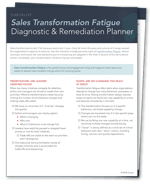 Checklist: Transformation Fatigue Diagnostic & Remediation Planner
Diagnose early signs of transformation fatigue, reduce overload, and ensure new behaviors are adopted with the help of this checklist.
The Pressure-Cooker Reality: Too Much Change Too Fast
Most revenue teams aren’t navigating one transformation. They’re often juggling change across several areas: process, ICP, messaging, tech stack, AI tools, account strategy, operating cadence, and more. All this, while still being expected to deliver results.
None of that is inherently bad. But it becomes a problem when it all hits at the same time and nothing gets removed to make room.
What Is Sales Transformation Fatigue?
Sales transformation fatigue is the performance and engagement drag that happens when teams are asked to absorb near-constant change while still carrying quota.
There are a variety of ways:
- Training attendance is fine, but behavior change is inconsistent
- Reps revert to pitching or generic discovery despite new messaging and training
- Messaging drifts across reps, teams, and regions
- Managers disengage because they’re overloaded
- Pipeline risk rises because execution becomes uneven
- Sellers stop believing “this training will stick” because the last three didn’t
Quick Self-Check: Does Your Organization Have Transformation Fatigue?
If three or more are true, your organization may be suffering from transformation fatigue:
- You’ve launched multiple “must-do” initiatives in the last 6 to 12 months
- Sellers are asking, “Just tell me what matters most right now”
- Managers spend more time reporting on change than coaching it
- Adoption metrics look “fine,” but execution is inconsistent
- Teams can’t explain the “why now” or “what’s in it for me”
- Different leaders are sponsoring different changes and no one is prioritizing across them
Why It’s Happening
Most transformations don’t fail because the strategy is wrong. They fail because the change is over-scoped, under-supported, and under-reinforced—and because leaders often under-communicate and under-prioritize the full change load.
Here’s a simple diagnostic:
- Scope: Are we trying to change too much at once?
- Support: Do people have the tools, examples, practice, and workflows to execute?
- Reinforcement: Are managers coaching this weekly for long enough to make it stick?
When any of these factors break down, fatigue rises and adoption falls.
Four issues tend to show up repeatedly when transformation derails.
1. Lack of clarity around new expectations and goals
When everything changes, people revert to what feels safest: the habits that used to work. If sellers can’t quickly answer, “What does good look like now?” execution will vary rep to rep.
2. Overambitious scope creates a productivity drop
Trying to change discovery, messaging, CRM hygiene, sales methodology, and AI usage all at once creates activity, not necessarily improvement.
Scope creep also creates a hidden problem: sellers and managers start making their own prioritization decisions, and execution becomes inconsistent across the organization.
3. Managers become the hidden bottleneck
Frontline managers are the hinge point for behavior change. If they don’t coach it, it won’t stick.
When managers are overloaded or unclear on what “good” looks like, they default to status updates, reporting, and firefighting. That’s the reinforcement gap.
4. Tech and AI accelerate, but workflows don’t get redesigned
New tools can help. But stacking tech and tools on top of unchanged workflows piles on complexity.
When sellers are asked to “use the tool” without a redesigned workflow and clear expectations, the tech becomes one more thing to learn, rather than a lever to improve execution.
3 Tactics for "Good" Transformation Design
When transformations work, leaders reduce cognitive load instead of adding to it. That means they do three things well:
- Simplify “good” into a small set of critical behaviors and build clarity of task around each one. Spell out what “done” looks like: the volume, timing, and the situations where it applies (e.g., accounts, deal stage, opportunity type).
- Sequence and pace change at a rate that lets sellers build one new muscle at a time.
- Reinforce through managers with a system that makes behaviors stick.
Managing these three levers, and reviewing and updating how they're applied as things change, is the difference between a transformation that loses momentum after launch and one that sticks.
Example: Redesiging an Off-Track Transformation
Imagine a mid-market company rolls out new value messaging, a tighter ICP, and a new standard for value conversations, all in one quarter. Training happens and participation is strong. Early feedback is positive.
But in the field, not much changes.
- Discovery still sounds the same: Reps ask questions but don’t lead with insight or a clear point of view.
- Value stays fuzzy: Problems come up, but impact and urgency don’t get quantified.
- Differentiation slips: Reps default to features instead of outcomes, proof, and trade-offs.
- Decision progress is unclear: There are “next steps” but no shared path to a decision.
- Mutual plans don’t stick: Stakeholders, milestones, and decision criteria aren’t aligned early.
- 1:1s turn into updates: Managers focus on status instead of coaching value and deal strategy.
- Forecast reliability drops: More deals drift, stall, or slip late.
The leadership team recognizes the need for a reset. They use the three tactics for good transformation design to change the trajectory of these flailing change initiatives.
1. Simplify
Instead of “do everything,” they choose three non-negotiables for the first 90 days:
- Lead the first meeting with a value conversation (why change, why now, and business impact).
- Build a Buyer Change Blueprint early (current state → desired future state → what has to change, who’s involved, risks, and milestones).
- Create a mutual plan by a defined stage with corresponding communication touch points (stakeholders, decision process, milestones, criteria, and next steps).
2. Sequence
They pause the nice-to-haves and build one muscle at a time:
First-meeting value conversation → deeper discovery and impact → Buyer Change Blueprint → mutual plan → opportunity reviews
3. Reinforce
Managers run a simple weekly cadence in call reviews and deal reviews: observe, coach, and inspect for value and decision progress. Enablement supports it with field-ready examples including talk tracks, discovery prompts, Buyer Change Blueprint templates, and quick practice tools.
In other words, the first (flawed) rollout changed the inputs (training and tools), but it didn’t change the field behaviors that drive outcomes. When leadership narrowed the program's focus, they gave their team clear, attainable goals that motivated change in high-impact areas.
Take Action: 7 Moves to Reduce Fatigue and Increase Adoption
1. Stop launching “programs.” Start shipping “plays.”
A play is a repeatable set of actions in a specific moment—first meeting, next-step lock, mutual plan build, opportunity review—supported by examples, practice, and manager coaching.
Convert transformation goals into two to three role-specific plays sellers can run this week.
Role clarity:
- Sales owns prioritization and accountability
- Enablement owns play design, examples, practice, and coaching tools
2. Sequence and pace change using a “one new muscle at a time” roadmap.
Tie sequencing to the reality that over-scoped rollouts drive overwhelm and inconsistency.
Use the example sequence above: First-meeting value conversation → deeper discovery and impact → Buyer Change Blueprint → mutual plan → opportunity reviews.
Role clarity:
- Sales owns trade-offs (what gets paused)
- Enablement owns sequencing plan and reinforcement plan
3. Simplify roles and workflows.
If seller roles and workflows stay complex, adoption will be fragile. Transformation won’t take hold on top of a confusing operating model.
Support is where transformations often break: sellers get training, but not the workflow, examples, and tools that make execution easier.
Role clarity:
- Sales/RevOps owns workflow design and tool rationalization
- Sales leaders own role clarity and decision rights
- Enablement owns training to the new workflow
4. Build manager capacity for coaching.
Provide a simple template managers can use in their weekly coaching meetings:
- 15 minutes: One behavior focus + what “good” looks like
- 20 minutes: Deal coaching tied to the play
- 10 minutes: Peer share (“what’s progressing / what’s stuck”)
Here are coaching prompts managers can use immediately:
- “What changed in the customer’s world that makes this urgent now?”
- “What does the Buyer Change Blueprint look like—current state, future state, and the path to change?”
- “Where is the buyer in their change process, and what’s the next decision they need to make?”
- “What’s the cost to the buyer of staying in the current state?”
- “Who else needs to be involved for this change to happen?”
- “What did we learn in discovery that should change our approach?”
- “Who else cares about this outcome, and how are we multi-threading?”
- “What’s the most likely reason this deal stalls, and what’s our prevention plan?”
5. Make AI a teammate (if you’re deploying it), not another tool to learn.
Integrate AI into moments that already exist (call planning, account research, follow-up) instead of adding steps.
Ask: Where should AI remove friction in the rep’s week without adding extra workflow?
Role clarity:
- RevOps owns integration and governance
- Enablement owns “work alongside AI” behaviors and guardrails
- Sales leaders own expectations (what changes in a rep’s week)
6. Reinforce behavior change for 8 to 12 weeks minimum.
Reinforcement is the difference between “we trained it” and “we do it.”
Practical reinforcement options include manager coaching, peer practice, pipeline/application assignments, call observation, and micro-reps.
Reinforcement could look like:
- Weeks 1 to 2: Model and practice (examples, role plays, guided reps)
- Weeks 3 to 6: Manager observation and coaching (calls, meetings, reviews)
- Weeks 7 to 12: Inspect leading indicators, peer share, and targeted refresh
Keep it doable. Focus on the first 90 days, then the next 90 days. Define what must change behaviorally in the first 90 days (and how you’ll measure it) before adding more.
7. Measure on behavior change, not vanity metrics.
Keep measurement tight and linked to behavior change in the first 90 days.
-
Vanity adoption looks like: Course completion, tool logins, “we rolled it out.”
-
Leading indicators look like: Better meeting outcomes, stronger next steps, higher-quality plans, improved conversions.
One measures activity. The other measures business impact.
Examples of leading indicators:
- Meeting outcomes (next step secured, agreement on problem statement)
- Quality of opportunity plans and mutual plans
- Conversion rates between stages
- Consistency of opportunity reviews (same criteria, same language)
- Evidence of multi-threading and stakeholder alignment
Role clarity:
- RevOps owns definitions and instrumentation
- Sales leaders own what gets celebrated and inspected
- Enablement owns how metrics connect to coaching and practice
Pause and Prioritize
If you want to reduce fatigue, you have to create space.
In the next 90 days, stop or park at least one of the following:
- A non-critical reporting change that steals manager time
- A secondary methodology add-on that isn’t tied to this quarter’s plays
- A “nice to have” tool rollout that isn’t embedded into current workflows
- A broad training push not connected to the two to three behaviors you’re reinforcing
In the real world, prioritization means removing something to make execution possible.
Someone Has to Lead Through the Noise
Even great content and training won’t help if the organization is dealing with multiple changes and shifting priorities with no one prioritization across it all. Reducing fatigue is a leadership and operating model issue as much as an enablement issue.
Fatigue-resistant transformations:
- Over-communicate to reconnect with the purpose (clear messaging around why / why now / what’s in it for me)
- Make trade-offs visible (including what gets paused)
- Establish a single point of accountability across the change portfolio
- Build a manager-led reinforcement system that runs long enough to stick
Key Takeaways
- Transformation fatigue is an execution design and planning problem. Over-scoped change, weak reinforcement, and unclear prioritization stall adoption and drive inconsistent execution.
- The fix is practical: simplify what “good” looks like, sequence and pace the change, and build reinforcement through frontline managers.
- Fatigue drops when leaders make visible trade-offs and assign one owner to prioritize across all competing initiatives.
Transformations Aren’t Going Away, but Fatigue Is Solvable
Sales transformations aren’t slowing down, but fatigue doesn’t have to be the cost of progress. A transformation sticks when leaders keep the purpose front and center: what’s changing, why it matters, and how it helps sellers win. Match that clarity with a realistic pace, strong manager coaching, and consistent reinforcement, and transformations start delivering results that last.


