




Sales kickoffs (SKOs) are among the most visible—and expensive—enablement plays. Too often, they spike morale for a few days, and then they fizzle out. Sellers go back to their desks with new swag and revert to their old selling habits. The chance to change behavior, build skills, and improve sales results is missed.
To learn what the organizations with the most impactful SKOs do differently, we analyzed 221 responses across sales leadership, enablement, and selling roles to find out which SKO elements positively correlate with behavior change (for the full analysis, read our report The SKO Shakeup: Running an Impactful Sales Kickoff, RAIN Group Center for Sales Research).
Five key drivers rose to the top (explaining 43% of the variance in behavior impact, according to our relative-importance regression analysis):
- Strategic alignment (31%)
- Motivation & team building (19%)
- Session interactivity (19%)
- Motivational guest speakers (16%)
- Roleplaying (15%)
Along with these, we uncovered three amplifiers that extend impact beyond the event: measurement, reinforcement, and rhythm.
Incorporating these elements makes it significantly more likely that your SKO will be a high-impact launchpad for the year’s priorities, not just a pep rally.
Why Many SKOs Miss the Mark
SKOs are high-profile, high-cost experiences meant to inspire, align, and equip the sales team, but many fail to change sales behavior and practices in measurable ways. In today’s budget-tight environment, leaders need SKOs to produce durable adoption, not just short-term enthusiasm. That’s why we set out to identify the elements that correlate with sustained behavior change.
The 5 Key Drivers of High-Impact SKOs
5 Key Drivers of High-Impact SKOs
% Relative Importance of Each Variable in the Model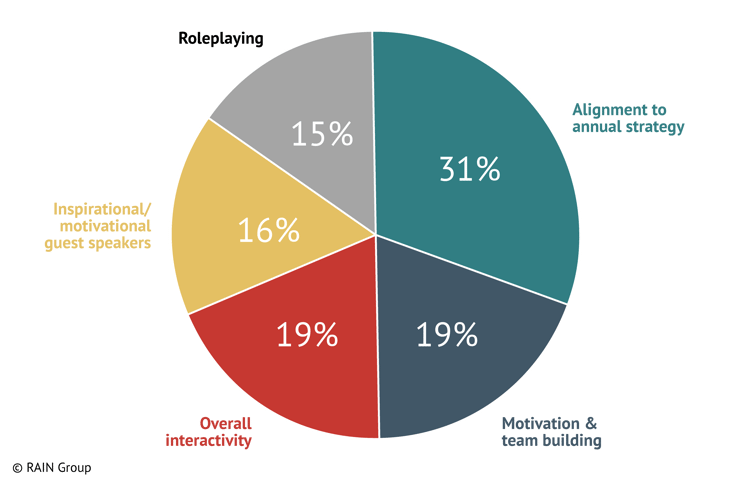
1. Strategic Alignment
High-impact SKOs are 1.8x more likely to be tightly linked to company strategy. But alignment alone isn’t enough; though; you need a clear “golden thread,” a unifying message that translates business strategy into sales actions. Connect the dots between corporate objectives and what sellers need to know, believe, and do differently to win. Every session, speaker, and exercise should reinforce this message.
Take action: Define the golden thread early on and use it to design the entire SKO experience. Sellers should leave your event knowing exactly how the strategy translates to their role and how they can execute it.
2. Motivation & Team Building
The best SKOs deliberately create social glue. Organizations reporting strong impact are 2x more likely to invest meaningful time in bonding that sustains collaboration, collective ownership, and accountability after the event.
Take action: Build in peer-led sessions, structured breakouts, team challenges, and recognition moments that connect people to one another.
3. Session Interactivity
To elevate your SKO and make an impact, focus on improving session engagement. Sellers will adopt new approaches if they experience the change themselves and see its value in action. Incorporating interactive elements ensures they not only understand the concepts, but also apply them in real conversations. Engagement activities can include roleplays (live or using AI conversation simulations), live actors, gamification, interactive panels, or social learning touchpoints.
Example: Bringing Learning to Life with Forum Theater
One company used a technique called forum theater to create an SKO experience that was both engaging and memorable. Forum theatre is a live, interactive learning format where professional actors perform scripted scenes that reflect real-world selling situations.
In this case, the actors portrayed common and challenging sales conversations. But here’s the twist: sellers in the audience could stop the action at any point and throw curveballs to the actors, just like in the television show Whose Line Is It Anyway? The actors then adapted in real time, incorporating the audience’s input and demonstrating how to respond under pressure.
This format allowed sellers to see both effective and ineffective selling behaviors played out in front of them, challenge assumptions, and explore alternative approaches in a dynamic, emotionally resonant way. It turned passive observation into active learning and created a shared experience that stuck with sellers long after the SKO ended.
What you do matters more than where you gather. High-impact SKOs are 2.7x more likely to be highly interactive (workshops, gamified activities, panels, peer showcases, etc.). We found no significant differences in impact by format (in-person vs. virtual vs. hybrid).
Voice of respondents: “The most successful element was the interactive discussion about specific sales tactics and wins.”
Take action: Brainstorm ways you can keep formats interactive to create an experience that engages sellers both intellectually and emotionally.
4. Motivational Guest Speakers
The most impactful SKOs are 2.8x more likely to feature external voices—customers, thought leaders, industry experts—who deliver inspiration and relevance tied to the strategy (remember the golden thread here). Speakers who know how to make their experiences and message relatable to the audience produce better engagement and buy-in.
Take action: Curate speakers who reinforce the narrative and your sellers’ reality; prioritize customers and credible practitioners.
5. Roleplaying
High-impact SKOs are 2.8x more likely to dedicate extensive time to realistic roleplays with coaching and feedback. This practice builds confidence and accelerates application (see Bringing Learning to Life Example above).
Take action: Base roleplays on live opportunities and current objections; pair with structured coaching and scorecards.
Debunking the Keynote Myth
Activities Contributing to Achieving SKO Objectives
% Strongly Agree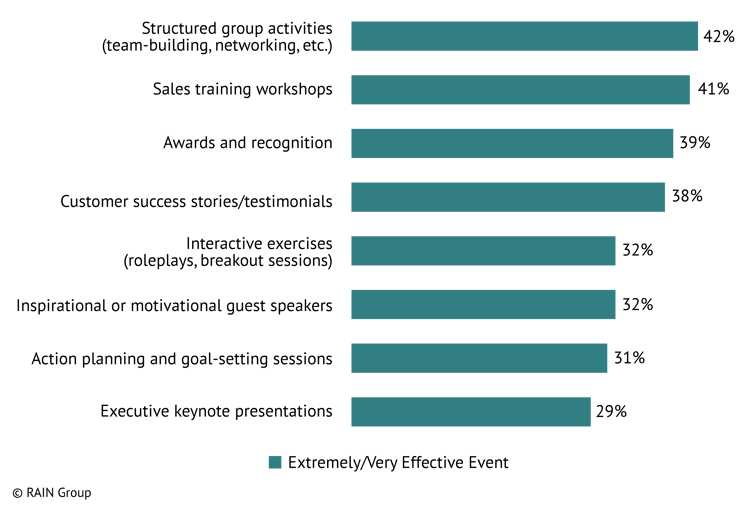
Myth: “Executive keynotes are the biggest value driver.” In orgs reporting highly effective SKOs, only 29% of respondents strongly agreed that keynotes contributed to achieving goals, putting this factor below team building, training workshops, and customer success stories. Keep leader remarks concise, strategic, and tied to the golden thread.
Beyond the Event: The 3 Amplifiers That Sustain Impact
Measurement
Organizations with less effective SKOs are 3.3x more likely not to measure SKO success at all. Conversely, orgs with high-performing SKOs use multiple signals and make ownership explicit. Metrics can include sales performance and sales activity metrics, along with manager feedback and observations, post-event surveys, employee engagement, adoption of key initiatives, etc.
When defining metrics, also consider how you’ll operationalize measurement:
|
Owners |
|
|
Baselines & Targets |
|
|
Cadence |
|
|
Signals to Watch |
|
Take action: Define KPIs, set targets, assign owners, and schedule readouts to drive accountability and transparency through consistent KPI reviews.
Reinforcement
Treat your SKO as a milestone, not the finish line. High-impact orgs are significantly more likely (2.5x) to include preparation and reinforcement outside the formal event, such as pre-work, structured coaching, microlearning exercises, gamification, and AI simulations.
Take action: Deploy weekly micro-tasks, AI roleplays, and pipeline reviews tied to SKO plays; add enablement nudges such as CRM prompts, manager coaching cues, just-in-time content links, and peer-sharing reminders to sustain adoption.
Rhythm
Cadence sustains energy and execution. High-impact orgs are 1.9x more likely to hold SKOs twice per year and about 2x more likely to run quarterly boosters.
Take action: Set a steady rhythm with annual SKOs, plus mid-year and quarterly boosters to sustain energy and execution.
What Impactful SKOs Look Like
When SKOs are aligned with strategy, designed around interaction and practice, and supported by measurement, reinforcement, and rhythm, they can evolve from costly gatherings into powerful systems for driving seller behavior change.