





When sales performance is under pressure, many organizations look first to pipeline. Are there enough qualified opportunities? Is there enough coverage? Is there enough activity to support the number?
That focus is often warranted. Without enough qualified opportunities, growth becomes difficult. Pipeline matters. It always has.
But the data suggests there’s more to the story.
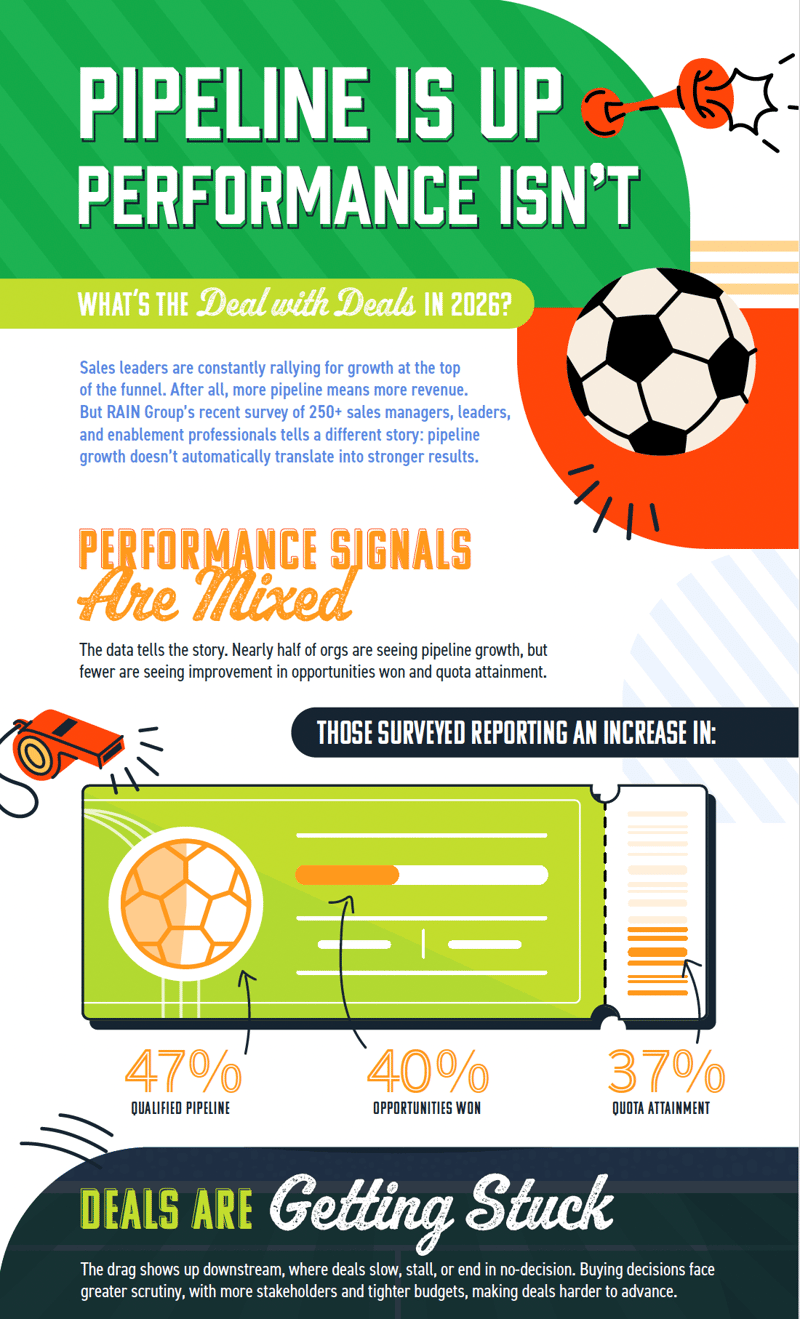
In RAIN Group’s 2026 Sales Challenges & Priorities research, 47.2% of respondents said the number of qualified opportunities in the pipeline increased over the past 12 months. That’s encouraging. But only 37.1% said the percentage of sellers hitting quota increased.
At the same time, 48.4% said sales cycle time increased.
So organizations are creating more pipeline, not converting enough of it, it’s moving more slowly, and quota attainment isn’t keeping pace.
For sales enablement leaders, that points to a different issue than “we need more pipeline.”
It raises a more revealing question: Where is performance breaking down?
Read on to find out, or explore the infographic for a visual breakdown of the state of sales performance in 2026.
Bridging the Pipeline Performance Gap
DOWNLOAD THE INFOGRAPHIC (PDF)
More Pipeline Doesn’t Always Lead to Better Performance
To be clear, I’m not minimizing pipeline. Stronger qualified pipeline is associated with stronger sales results. Organizations that improve pipeline are more likely to report stronger quota attainment and more opportunities won.
But more pipeline ≠ more closed deals.
A sales team can have more opportunities and still struggle to win. Sellers can create qualified pipeline and lose momentum later in the deal. Managers can see more in the forecast and still miss the signs that opportunities are slipping.
This is where diagnosis matters.
It’s easy to look at the pipeline number and assume the next move is more activity. More outreach. More leads. More prospecting. In some cases, that’s exactly the right response.
In others, the issue is something else:
- The conversion or deal strategy needs review
- Sellers aren’t creating enough urgency
- Sellers aren’t reaching the right stakeholders
- The value case isn’t strong enough
- Managers aren’t coaching what matters most
These are different problems and they call for different responses.
The Gap Between Pipeline and Quota Is Where Diagnosis Starts
One of the areas we look at closely in the research is the relationship between pipeline growth and quota attainment.
When both are improving, that tells one story.
When pipeline is improving but quota attainment is not, that tells another.
When both are under pressure, the issue is different again.
And when quota attainment improves even without strong pipeline momentum, leaders should understand what’s working before that advantage fades.
The four performance profiles that emerged in our research are: Growth Leaders, Conversion Constrained, Stalled Performers, and Lean Performers. These profiles clarify whether an organization is primarily facing a pipeline problem, a conversion problem, both, or stronger execution despite pipeline pressure.
The profiles are meant to be diagnostic. They help leaders look past the average and ask, “What kind of performance problem are we dealing with?”
From a distance, a pipeline problem and a conversion problem can look similar:
- Revenue is under pressure
- Forecasts are uncertain
- Sellers are frustrated
- Managers are trying to help
- Enablement is expected to respond
But once you look more closely, the root causes are very different.
Same Market Pressures, Different Performance Patterns
Most sales organizations are dealing with familiar challenges right now:
- Cautious buyers
- More stakeholders
- Budget scrutiny
- Longer sales cycles
- Stalled deals
And no-decision remains a persistent issue.
In the research, 28.2% of respondents said losing deals to no decision or the status quo is very challenging at the organizational level. Among those who rated reducing no-decision as very important, 40.8% selected it as a top 3 priority.
That matters because no-decision is rarely just a late-stage sales problem. It often shows up earlier than that.
It can show up when the buyer doesn’t see enough value in changing, there’s no shared urgency, the seller hasn’t helped the buyer connect the problem to business impact, or the buying group isn’t aligned.
In those situations, simply adding more pipeline is unlikely to solve the issue. It may create more activity, but it may also create more stalled deals.
This Is an Enablement and Leadership Issue
Sales enablement teams are often asked to improve performance, but performance rarely changes because sellers attend a program or receive a new playbook. It changes when sellers apply the right behaviors consistently in the field, and that often requires manager support.
Managers help sellers think through stakeholders, value, risk, differentiation, and next steps. When managers aren’t equipped to do that, enablement has less leverage.
This is why the pipeline-to-performance issue connects directly to manager development.
If the problem is conversion, sellers need help improving how they manage opportunities. Managers also need to know what to look for, how to coach it, and how to reinforce it over time. Without reinforcement, training fades and sellers tend to fall back on what they already know.
Diagnose Before You Prescribe
One of the most common mistakes I see is moving too quickly to the solution.
If pipeline is down, the answer could be prospecting, targeting, account planning, or qualification.
If pipeline is up but quota attainment is flat, the answer could be opportunity strategy, value communication, stakeholder engagement, or deal coaching.
If sales cycles are lengthening, the answer could be helping sellers create urgency and a stronger case for change.
If no-decision is the issue, the answer could be less about objection handling and more about helping buyers make sense of risk, impact, and the cost of staying the same.
Sales enablement leaders can’t address every issue at once. The work is to identify the performance constraint that matters most and focus there.
That means more focused enablement tied to the actual performance pattern.
Beyond the Pipeline: Next Steps for Enablement Leaders
In our research breakdown session "When Pipeline Isn't the Problem" (now available on-demand), I dive deeper into what our new B2B Sales Challenges Report revealed, including the performance profiles that emerge when we look at pipeline and quota attainment together.
The goal is practical: I want sales enablement and talent development leaders to leave with a clearer way to diagnose where performance is breaking down and where to focus next.
As you’ve read, the answer isn’t always more pipeline.
It may be better conversion. It may be stronger manager coaching. It may be sharper value communication. It may be more disciplined execution.
But the first step is always knowing which problem you’re trying to solve.