





Most teams serve their accounts’ known needs well enough, but few set aside structured time to co-create new value for these clients. That’s where Value Labs come in. In a focused, facilitated session (internal, or with account stakeholders), your team clarifies a growth challenge, explores what will make or break success, generates bold ideas, and commits to an action plan with owners and dates. The results are stronger relationships, bigger deals, and faster expansion inside current accounts.
Plan Account Growth with Value Labs
- What Is a Value Lab?
- Why Value Labs Work
- Internal vs. External Value Labs: Choosing Your Approach
- The 4-Stage Value Lab Framework
- Leading a Successful Value Lab
- Facilitation Best Practices
- Leading Companies Use Value Labs to Drive Growth
- Co-Create, Innovate, Deliver: Grow Your Accounts with Value Labs
What Is a Value Lab?
A Value Lab is a facilitated working session bringing together participants with different perspectives that moves an account from assumptions to shared insight to prioritized initiatives to, ultimately, committed action.
ASSUMPTIONS → SHARED INSIGHT → PRIORITIZED INITIATIVES → COMMITTED ACTION
Think of it as account planning reinvented. A Value Lab goes a step beyond pipeline updates and forecast reviews to a strategic collaboration that produces measurable results.

Why Value Labs Work
RAIN Group research shows 72% of sellers say their accounts are willing to collaborate, yet most lack the structure or tools to do it effectively.
Buyers reward sellers who:
- Educate clients with new perspectives
- Collaborate to design solutions
- Persuade that results will happen
Value Labs formalize these behaviors and connect them to a clear value proposition, resulting in ideas that:
- Resonate, or align with the client’s strategic objectives
- Differentiate, or co-create unique approaches to meaningful problems
- Substantiate, or support with evidence, metrics, and next steps
In short, Value Labs help you surface ideas, structure collaboration, and link every discussion back to measurable client outcomes.
3-Question Idea Evaluation
- Do we have a shared “How do we...” growth question?
- Have we mapped stakeholders, priorities, and risks?
- Can we prove outcomes? By when?
Internal vs. External Value Labs: Choosing Your Approach
Value Labs can be either internal or external. When do you use each type?
Internal Value Labs bring your team together to develop strategic account plans and bold ideas before engaging clients. Use these when you need to align internally, develop your value proposition, or prepare for a major client engagement.
External Value Labs bring clients directly into the collaboration process. In these sessions, you and the client work together to define opportunities and develop a shared action plan. The goal is to create shared ownership. When buyers help define the challenge and design the solution, they become invested advocates for action.
Use external Value Labs when you have:
-
Executive-level access and sponsorship
-
A collaborative relationship with mutual trust
-
Clear alignment on business objectives
-
Client willingness to invest time in co-creation
The same four-stage framework applies to both formats, but external labs have the added impact of emphasizing participation and psychological ownership. When clients co-create, they champion the outcomes internally.
The 4-Stage Value Lab Framework
Both internal and external Value Labs follow the same proven approach for turning collaboration into concrete action.
The 4 Stages of Structured Problem SolvingSM
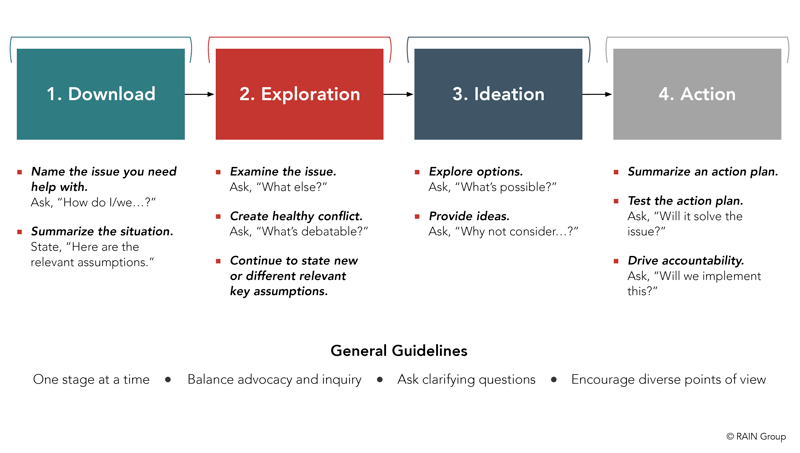
Stage 1: Download—Frame the Opportunity
Start by clarifying what you're solving for. The best problem-framing conversations begin with "How do we...?" because this phrasing invites collaboration and focuses on opportunity.
Strong problem-framing questions are specific, measurable, and actionable:
-
How do we double the size of this account in 12 months?
-
How do we secure C-level executive sponsorship?
-
How do we expand from IT into marketing and operations?
Weak problem-framing questions lack specificity and action:
-
How do we get more revenue from this account?
-
What do we do with this client?
Strong problem-framing questions work because they give the team a clear target rather than a vague aspiration.
Give all participants a chance to speak and confirm everyone agrees on the problem before moving on. Don’t try to jump to solutions; your goal here is to establish a shared starting point.
Stage 2: Exploration—Identify Success Factors
Next, you’ll explore the factors that could impact success or failure. Ask probing questions:
-
What value have we delivered to similar accounts?
-
Have there been major changes in the client's priorities or key stakeholders?
-
Where might we not be living up to expectations?
-
Are solution impacts being tracked and reported in the dashboards clients see?
Encourage healthy debate—diverse viewpoints surface the best insights. Capture key assumptions such as:
-
We don't have an executive sponsor yet.
-
We could expand globally but haven't tried.
-
We may not know all buying influences.
Stage 3: Ideation—Generate New Value Ideas
When you’re ready to shift into creativity mode, open the discussion to questions like:
-
How can we support the client's agenda using our offerings?
-
Can we co-create new approaches together?
-
Have we reverse-engineered our solutions to uncover untapped value?
Encourage volume and diversity. Don't filter ideas yet. Use "Yes, and..." thinking to build momentum. Capture ideas visually using whiteboards, digital sticky notes, or shared documents. Build on each other's contributions and avoid dismissing thoughts too soon.
Stage 4: Action—Prioritize and Commit
Once you’ve captured a broad array of ideas, you’ll turn to execution. Select three to five initiatives that deliver the greatest impact. Test each one:
-
If we implement this plan, will it achieve both our goals and the client's?
-
Can we realistically implement this?
Assign owners, timelines, and next steps. Create forcing mechanisms, such as client presentations or internal checkpoints, to ensure accountability.
Tip: Only commit to actions that are attainable and likely to yield measurable results.
Leading a Successful Value Lab
Before you schedule your Value Lab, you need to do some prework to ensure you have a clear vision for what you want to discuss, who should be there, and what you want the outcomes to be. You should:
1. Define Your Objective
- What business outcome are you targeting?
- Would an internal or external session better match your goals?
2. Gather Context
- Pull key data, such as spend, stakeholders, initiatives, risks, and wins
- Summarize recent conversations and account trends
3. Frame the Problem Statement
- Draft your "How do we...?" question:
- “How do we...[verb] [result] by [timeframe] for [stakeholder]?
- Test it for specificity and measurability
4. Assemble the Team
Include a mix of roles for diverse perspectives, such as:
-
Results Driver for business outcomes focus
-
Relationship Lead for client understanding
-
Innovator for creative thinking
-
Project Manager for execution focus
5. Define Success Metrics
Set measurable targets. For example:
- Renewal %
- Expansion $
- Sponsor secured by date
- Adoption KPIs
Facilitation Best Practices
Running a Value Lab is about creating an environment where everyone’s best ideas surface; it’s not about delivering your own answers. Be sure to:
-
Keep groups small (5-7 participants)
-
Ensure everyone contributes (e.g., round-robin sharing format)
-
Move through one stage at a time without skipping ahead
-
Balance advocacy (making a case) and inquiry (asking, testing)
-
Ask clarifying questions ("Can you say more?", or, "Did I get this right?")
-
Visualize everything (use whiteboards or screens)
And, if senior leaders dominate discussions, appoint a neutral facilitator to maintain balance and encourage participation from all team members.
Sample Value Lab Agenda
Here’s how a 60-minute Internal Value Lab might flow:
-
Download: Define success, align on objective (10 minutes)
-
Exploration: Identify factors and risks (15 minutes)
-
Ideation: Brainstorm and capture ideas (20 minutes)
-
Action: Prioritize and assign owners (15 minutes)
When you get several people into a room, it’s easy for time to get away from you. It may help to introducing the four stages via email or in the calendar invite with questions to get participants thinking ahead of time. To stay on track, set a timer for each stage to ensure you save enough time for the action phase.
Avoiding Common Pitfalls
Even skilled facilitators can fall into traps that derail Value Labs. Here are some of the most common mistakes and how to avoid them:
-
Pitfall: Skipping Straight to Solutions
-
Fix: Enforce stage discipline. When someone jumps ahead, pause with: "Let's capture that for Stage 3."
-
-
Pitfall: Dominant Voices Drowning Out Others
-
Fix: Use round-robins or silent brainstorming to ensure full participation.
-
-
Pitfall: No Clear Ownership
-
Fix: In Stage 4, always assign specific owners, deadlines, and follow-up dates.
-
-
Pitfall: Momentum Dies After the Session
-
Fix: Schedule follow-ups, client reviews, or check-ins within two weeks.
-
Leading Companies Use Value Labs to Drive Growth
Across industries, leading organizations have adopted Value Labs to drive stronger collaboration, uncover new opportunities, and achieve meaningful business outcomes. These sessions are transforming how teams engage clients.
“I coached teams on running Value Labs, which was incredibly insightful. Bringing the team together intentionally fostered a cross-pollination of ideas.”
– Director, Learning & Talent, Global Technology Consulting Firm
“The Value Labs are amazing. I love the collaboration and ideas that come from different people and groups. We've made ‘Value Labbing’ a go-to within our organization. We've witnessed incremental to transformational gains—a wonderful improvement in how we engage clients and grow business.”
– EVP, Americas, APAC, and Europe, Automotive Consulting Firm
“A competitor came in and told our client they could replace our services for a fraction of the cost. Rather than get into a price war, we ran an internal Value Lab to explore how we could increase the client’s value. Then we hosted an external Value Lab with them. The session revealed new challenges we could solve—and we not only secured the renewal but built internal champions who now advocate for us.”
– Participant, Professional Services Firm
“The Value Lab brought out the best team discussions among peers.”
– Strategic Account Manager, Industrial Operations Provider
These stories show how Value Labs create a repeatable structure for insight and innovation. Teams move beyond routine account management to genuine partnership, building trust and driving sustainable growth.
Co-Create, Innovate, Deliver: Grow Your Accounts with Value Labs
Internal Value Labs are powerful tools for identifying and pursuing revenue growth opportunities. Top-performing sales teams use these action-oriented workshops to proactively bring new ideas to key accounts, positioning themselves as partners in value creation.
Adopting Value Labs is a strong tactical move because:
-
Your biggest growth potential lies within your current accounts
-
Collaboration differentiates winners; Value Labs make it repeatable
-
The 4 Stages of Structured Problem Solving framework turns ideas into measurable action
-
Top performers don't wait for insight; they create it through structured collaboration
When diverse perspectives engage in structured problem-solving with the goal of delivering exceptional value, account relations thrive.