




Your biggest growth opportunities are often hiding in plain sight within the accounts you already serve. The key to unlocking them isn’t selling harder—it’s collaborating better.
External Value Labs are structured, client-facing sessions where you and your buyers work together to identify new ways to create value. They move beyond presenting ideas to co-creating them, turning collaboration into tangible progress clients want to own.
While the Value Labs framework covers both internal team alignment and external client collaboration, this article focuses specifically on how to run external sessions that deepen partnerships and drive client commitment.
If you’re new to Value Labs, read the starter guide: How to Run a Value Lab: Collaborate to Grow Key Accounts.
Running an External Value Lab
What Is an External Value Lab?
An external Value Lab is a facilitated, collaborative meeting between your account team and client stakeholders. It’s designed to:
- Co-discover opportunities for mutual growth
- Co-develop solutions to strategic challenges
- Strengthen shared commitment to action
Unlike internal Value Labs, in which your team aligns behind closed doors, external Value Labs bring the client directly into the process. You move from presenting ideas to the client to building ideas with them.
Here’s the key distinction:
- Internal Value Labs: Develop ideas, align your team, prepare strategy
- External Value Labs: Co-create solutions, build client ownership, drive commitment
These sessions are especially powerful when you want to reenergize a key account, build executive alignment, or move from vendor to trusted partner.
The Power of Psychological Ownership
The secret to successful external Value Labs lies in helping clients feel ownership of the outcomes.
When clients co-author a solution, they become its champions. They’ll fight for budget, defend against skeptics, and ensure success because it’s their idea too.
Psychological ownership drives commitment and advocacy. Here’s how to create it:
- Give them control: Let clients shape the agenda and prioritize ideas. Don’t just present options, invite them to modify and build on your thinking.
Ask: “What would you add to this approach?”, or, “How would you sequence these priorities?”
- Build their expertise: Share context and data so they see the bigger picture.
Ask: “How does this connect to your other initiatives?”, or, “What have you tried before in this area?”
- Invite their investment: Encourage contribution and refinement so that their fingerprints are visible on the final plan.
Ask: “What would make this work better for your team?”, or, “What’s missing from this picture?”
When and Why to Run External Value Labs
External Value Labs work best in specific scenarios. Use them when you want to:
- Introduce new strategic ideas or initiatives
- Align multiple stakeholders around a shared goal
- Deepen enterprise-level relationships
- Co-create a roadmap, transformation plan, or joint initiative
- Break through stagnation and move from reactive service to proactive partnership
Before scheduling an external Value Lab, ensure you have:
- A trusted relationship; the client sees you as a partner, not just a vendor
- A clear business challenge or opportunity worth exploring collaboratively
- An executive sponsor who can act on outcomes
- Internal alignment; your team has already run an internal Value Lab
- A collaborative mindset on the client side
Communicating with the Client
Securing the Meeting
Getting the meeting often determines success. How you ask matters as much as what you share. Be direct, clear, and value-driven:
“We’ve been developing a few ideas that might help accelerate your expansion into new markets. We’d love to explore them in a working session. Not a presentation, but a collaborative discussion where we build the approach together.”
Handling Common Objections
Even with the right framing, buyers often hesitate to commit to a working session. Here’s how to respond to common pushbacks while keeping the conversation collaborative.
-
If they say: “Just send me the deck.”
Respond with: “I could send slides, but that defeats the purpose. The value comes from combining your team’s insights with our ideas. Even 90 minutes together generates better solutions than any deck I could send.” -
If they say: “What exactly will we cover?”
Respond with: “We’ll focus on [specific challenge]. I’ll bring initial ideas, but the session is designed to build on your team’s expertise. Think structured brainstorming with purpose.” -
If they say: “Who needs to be there?”
Respond with: “Ideally, [specific roles]. Their perspectives will help us reach the best solution quickly. These sessions work best with 4-6 people who bring different viewpoints.”
Sample Outreach Email
Here’s an example of how to position the session in writing that’s concise, collaborative, and focused on joint problem-solving rather than presentation.
Subject: Strategic Discussion: Accelerating [Specific Goal]
Hi [Name],
I’ve been thinking about your goal to [specific objective] and have developed a few ideas that could help accelerate progress.
Rather than a standard presentation, I’d like to propose a collaborative working session where we explore these ideas together and build an approach that fits your situation.
The session would:
- Take two hours (flexible as needed)
- Include [suggested participants]
- Focus on co-creating solutions, not reviewing proposals
- End with clear, shared next steps
Could we schedule time in the next two weeks? I’m confident we’ll leave with actionable ideas your team is excited to pursue.
Best,
[Your Name]
Preparing for an External Value Lab
Preparation determines whether the meeting feels like collaboration or a presentation.
- Start internally: Run an internal Value Lab to align your team and refine your perspective before involving the client.
- Map key players: Identify participants, understand priorities, and anticipate dynamics.
- Prepare your point of view: Bring 2-3 strong ideas but hold them lightly; the goal is co-creation.
- Anticipate resistance: Prepare data or reframing questions for likely objections.
- Define mutual success: Be explicit about shared goals and outcomes.
- Create materials that invite participation: Use visuals, worksheets, or frameworks that encourage input.
Session Duration Guidelines
Once your client is on board, plan session length by scope. For example:
- 60 minutes: Focused topic, 2-3 stakeholders
- 2-3 hours: Strategic planning, 4-7 participants (ideal for most sessions)
- Half-day: Transformation or multi-department planning
It’s better to have focused time with the right people than a longer session with partial attendance. You may also get some valuable feedback in your communications with clients to help you structure this in a way that will be most valuable to them.
Best Practices for Leading External Value Labs
Beyond the 4-stage framework, these best practices ensure your external Value Lab runs smoothly, keeps participants engaged, and delivers results.
Before the Session
- Set the structure and the stage: Schedule at least an hour (ideally more) and share an agenda in advance.
- Invite the right mix: Include a diverse mix of stakeholders for broader insight and stronger buy-in. Mix seniority levels and functional areas, when possible.
During the Session
- Facilitate, don’t pitch: Guide discussion with questions. Early on, speak less than you listen; let clients co-own ideas from the start.
- Balance enthusiasm and restraint: Show energy for possibilities and remain curious. Listen for what’s not being said.
- Document visibly: Capture insights in real time, using a whiteboard, screen share, or flip charts everyone can see, for transparency and momentum.
After the Session
- Follow up fast: Send a concise summary within 24 hours outlining key decisions, owners, and next steps.
Virtual Adaptation
Whether in-person or virtual, the same principles apply. When running Value Labs remotely:
- Use collaborative tools (Miro, Mural, shared docs)
- Build in more breaks (10 minutes each hour)
- Engage participants by name more often
- Use polls or chat for quick input
- Record sessions for reference
How to Facilitate an External Value Lab
Follow the same 4 Stages of Structured Problem Solving framework used in internal Value Labs, adapted for client collaboration.
The 4 Stages of Structured Problem SolvingSM
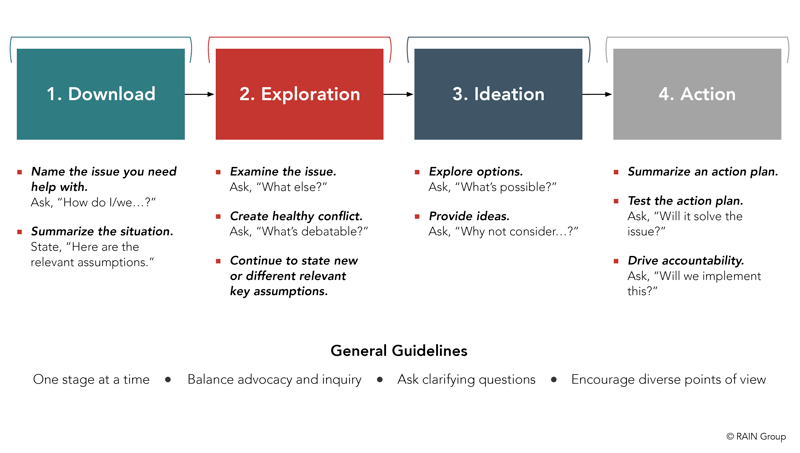
Stage 1: Download – Frame the Challenge Together
Begin by clarifying the opportunity or issue. This stage aligns everyone on what you’re solving for. Start with context: “We’d like to explore whether expanding into new markets could be accelerated through joint initiatives.”
Then, invite their perspectives:
- Does this align with your priorities?
- What would success look like from your perspective?
- Are there additional factors we should consider?
Keep it conversational and inclusive. This is where ownership begins.
Stage 2: Exploration – Uncover Insights and Assumptions
Deepen understanding before moving to solutions. Ask open questions:
- What value have we delivered so far, and where could we deliver more?
- What challenges are you seeing across teams?
- Who else needs to be involved for success?
Encourage diverse perspectives and healthy debate. Surface assumptions and constraints. Understanding precedes innovation.
Stage 3: Ideation – Co-Create New Value
Open the floor for creative thinking. This is where collaboration becomes co-creation. Use prompts like:
- What’s possible if we combine our capabilities differently?
- Could we approach delivery in a new way?
- Is there an untapped opportunity we haven’t explored?
Encourage quantity over perfection. Build momentum before filtering.
Facilitator Tip: Keep energy high. Use “Yes, and…” thinking. Capture everything visually.
Stage 4: Action – Align and Commit
Turn ideas into concrete next steps. Together, define:
- What needs to happen next?
- Who owns each step (both sides)?
- When will we reconnect?
- How will progress be measured?
Test commitment. Ask: “If we move forward with this plan, will it achieve both your goals and ours?”
Only commit to actions that are realistic, measurable, and mutually beneficial. End by scheduling your next touchpoint: “Let’s reconnect Tuesday to refine the plan and confirm resources.”
Avoiding Common Pitfalls
Even experienced facilitators face challenges. Here’s how to navigate them:
|
Pitfall |
How to Avoid It |
|
Talking too much early |
Ask more questions; let clients co-own discovery. |
|
Missing key stakeholders |
Map and invite decision-makers early. It’s often better to re-schedule than to proceed without them. |
|
Treating it like a pitch |
Focus on exploration and co-creation; otherwise you risk clients disengaging. |
|
Overpromising next steps |
Be realistic; under-promise, over-deliver. |
|
Losing momentum afterward |
Schedule a follow-up before closing the meeting. Send notes within 24 hours. |
You can use these same principles to establish a foundation for collaboration among stakeholders in your org when running an internal Value Lab.
External Value Labs help clients take ownership of outcomes and help you earn trusted partner status. For a worksheet, video, and guide, download the Value Labs Toolkit.