





Value is central to closing deals, but every sales org describes their value differently. To complicate matters further, no two customers perceive value the same way, even in the same sector.
Top sellers are much better at getting buyers to perceive maximum value than the rest. In fact, in our research, only one factor—"overall value was superior”—was of top importance to buyers in all of the categories we studied (e.g., how winners win the initial sale, what drives repeat business, what drives referrals, etc.).
Underpinning each specific value case is your value proposition. In this article, we explore the importance of a strong value proposition and how to create one that helps communicate the unique advantages your organization brings to the table.
What Is a Value Proposition?
Your value proposition is a statement detailing why a buyer should buy from you. This includes competitor differentiation and is supported by relevant statistics to help prove the benefits of working with you and your brand.
Value propositions are sometimes confused with elevator pitches. Though they have some elements in common, value propositions are more in-depth and tailored for your Ideal Customer Profile (ICP).
Don’t get me wrong. It’s helpful to be able to pick key points that often resonate with buyers and have them at the ready for discovery calls with new leads. And, like an elevator pitch, your value proposition should be clear and concise.
This summation is called a value proposition positioning statement. If you only do this, though, you’ll limit your possibilities for building the maximum case for your value with clients during the selling process.
If you think of a value proposition not as a statement, but as a concept about why people buy something, then you’ve got a lot more to work with. With an understanding about how this applies to your organization, you can put your selling efforts to work much more effectively, combining the components of your value proposition with different methods of communication to match your buyer.
The Importance of a Value Proposition
Your value proposition should be written to target key decision makers. As such, it gives you a shorthand to communicate how your organization can help alleviate pain points and attain goals. With limited time to impart this information, being able to understand and present your value proposition is a critical seller capability.
In addition, buyers are more informed than ever. Many join conversations having already researched you and your organization. Your value proposition is what elevates you above buyers’ existing assumptions, educates them on new possibilities, and guides them toward a solution they’re invested in.
The collection of reasons why people buy typically fall into three major buckets that form the three rules of winning value propositions:
- Buyers have to want and need what you’re selling. You have to resonate.
- Buyers have to see why you stand out from the other available options. You have to differentiate.
- Buyers have to believe that you can deliver on your promises. You have to substantiate.
Components of a Value Proposition
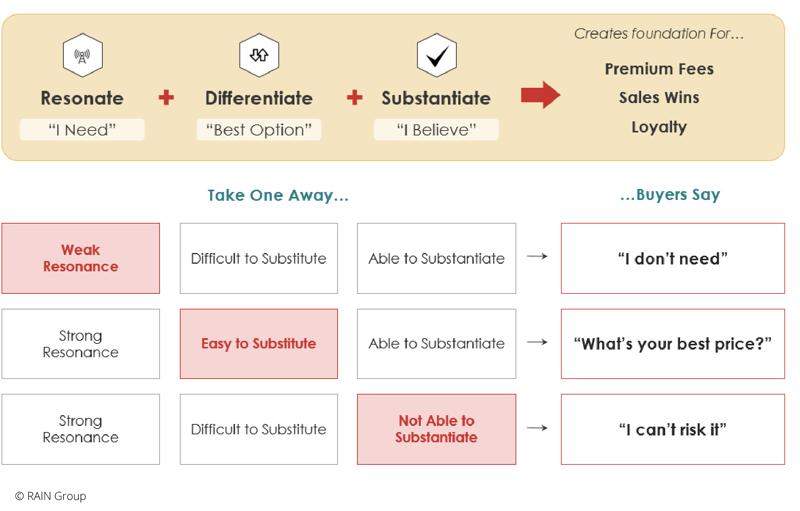
What happens if you don't follow all three of the value proposition rules?
As you can see from the graphic above, take any one of these away and it makes it much more difficult to sell.
- Remove resonance and people just won’t buy what you’re selling or won't buy it from you, because what you bring to the table isn't important enough. They also won’t be willing to move forward with any amount of urgency.
- Remove differentiation and there’s no clear indication that you’re the best choice. The buyer will pressure your price or attempt to get it someplace else.
- Remove your ability to substantiate your claims and buyers won’t risk working with you. They won’t believe you’ll be able to fulfill your promises or achieve intended results.
Again, statements that encapsulate the mission and value of a firm are helpful early in discussions. Many buyers are skeptical at this stage, especially if you and your organization are an unknown quantity. It takes time to resonate, differentiate, and substantiate, but it’s worth doing.
By summing up your organization in this way, you help buyers understand where and when you can help them. However, there’s always a set of underlying factors and specifics that sway any particular buyer to choose you instead of building an in-house solution, finding someone else to help them, or deciding to do nothing at all.
This is where a strong value proposition helps. You need to convince the buyer of the impact of your solution, and what will happen if they move forward with you compared to these other options. To take this a step further, a sales impact model can help you demonstrate financial benefits of working with you and map out the context of your offer.
To fulfill these three rules, you need your buyers to be able to answer four important questions.
Your Ideal Customer Profile
You can’t write a universally appealing value proposition, but by designing it around your Ideal Customer Profile, you can give yourself the best odds of success.
Your ICP describes an organization that is best matched to benefit from your solutions, particularly as part of a long-term customer relationship. Note that your ICP is not static; with the breakneck pace of market change, it’s worth reevaluating on a semi-annual basis. It typically includes:
- Company size
- Industry
- Budget
- Common objections
- Pain points
- Aspirations
- Motivation for buying
- Their buying process
- Technological infrastructure
- Decision maker structure (i.e. buying committees vs. individual buyers)
4 Questions to Build a Value Proposition
Your value proposition will serve you throughout the sales process. Even if your buyer has approved your solution, they must also present it to other decision makers and stakeholders. You can’t be in the room with them, so you’ll have to ensure they’re armed with everything they need to make a compelling case.
Just as you’ve had to resonate, differentiate, and substantiate yourself and your solution to get this far, so too does your buyer. If you can succeed, you’ll have someone in the buyer’s organization willing to champion you, even when you’re not in the room.
If you want buyers to be armed with the best material to make this case, first you must be able to make it to yourself.
The most successful sellers make the value case to themselves as powerfully as possible—before getting buyers to believe in it just as strongly. Making the value proposition case is straightforward if you ask the following questions.
4 Essential Value Proposition Questions
- Why act?
- Why now?
- Why us?
- Why trust?
Why act and why now cover resonance. Here you make the case for why it's important and urgent to move forward.
Why us covers differentiation. Here you make the case for why you are the best choice among available options.
Why trust covers substantiation. It's where you make the case for why the buyer should believe in you, your offering, your company, and your ability to achieve the desired and promised results.
In this video, we share more about these 4 questions and why it's important to customize your value proposition for each buyer.

Mapping Out Your Value
If you answer these 4 questions, covering each of the essential components, you win sales at premium fees and inspire buyer loyalty.
If you want to resonate, differentiate, and substantiate you need to do much more than write a short pitch. While you can sum it up, the summary itself isn't enough to drive the buying decision. It just does a little positioning for you.
Your actual value proposition—the collection of reasons people buy from you—will be different from one buyer to the next. You’ll discover what it should be for each buyer through your conversations as you learn what they want and need, and who the competition is.
Then and only then will you be able to craft the most compelling solution and messaging for them.
If you do, the buyer’s perception of your value will be as strong as possible when it counts: when it’s time to buy.