





C-suite buyers expect sellers to connect what they sell to the business results executives are accountable for. That requires understanding the financial context behind those priorities and using it to build a credible value case.
Financial information can provide an important starting point. It can show where the business is performing today, where leadership is trying to improve results, and where gaps may exist. Sellers who can interpret those signs are better prepared to connect their capabilities to measurable business value.
What Is Financial Acumen?
Financial acumen is the ability to understand how a company creates economic value and use that understanding to connect a solution to the outcomes senior executives care about. This doesn’t mean you have to become a financial analyst, but you do need to understand enough of your buyer’s business to build a value case grounded in their financial and strategic reality—and priorities.
The value case needs to translate what your solution does into what could change for the business. That means identifying the relevant financial or strategic gap, showing credible evidence of the results you can help produce, and connecting those results to what the executive is trying to achieve.
How to Build the Foundations of a C-Suite Value Case
When preparing for an executive conversation, focus on three areas.
1. Understand Your Buyer’s Numbers
Before the meeting, learn as much as possible about the organization’s financial performance. Give special attention to the metrics that matter to your buyer’s role, but make sure you also understand the organization’s overall financial position and resources to ensure any solutions you propose make sense in their context.
Many public companies publish extensive financial information, which can feel overwhelming if you aren’t used to navigating these documents.
A good place to start is the income statement, often called the profit and loss statement (P&L). It can reveal trends in revenue, costs, profitability, and operating performance that may help you identify where your solution will create value.
If your solution influences revenue growth, cost reduction, productivity, efficiency, customer acquisition, retention, or profitability, you’ll often find clues within the P&L that can help shape more resonant conversations.
Financial literacy tells you what the numbers are; financial acumen helps you interpret what those numbers may mean for the business and where your solution could create value.
Start with these questions:
- Where is the company now? Look at revenue, growth, margins, profitability, and relevant operating metrics.
- Where is leadership trying to go? Look for stated targets, strategic initiatives, investor commitments, and management priorities.
- Where is the gap? Identify areas where current performance and stated ambitions diverge.
Other questions to explore include:
- How is revenue trending?
- What are their profitability targets?
- Are margins improving or declining?
- What growth objectives have leadership communicated?
- How do they compare to competitors?
Beyond the individual metrics, look for the story behind the numbers. Identifying the gap between where the organization is today and where leadership wants it to be can reveal business pressures and priorities worth exploring. Use that information to identify where your solution may create value, then validate that connection with the executive.
2. Support Your Claims with Credible Outcomes
Customer stories are most useful when they provide evidence an executive can evaluate. Whenever possible, ground them in measurable outcomes.
With client results, instead of saying, “We helped improve sales performance,” you can say, “We helped increase win rates by X% while reducing sales cycle length by Y%.”
Then, take it further. What became possible for that client that wasn’t before working with you? How did it impact revenue, margin, productivity, customer retention, or profitability? How did these results advance the company’s strategic objectives?
If you have a relevant executive reference, consider offering an introduction. The buyer may never take you up on it, but a credible reference can add weight to the evidence you present.
Executives want evidence. Putting numbers into the context of the buyer’s strategic goals is what transforms anecdotes into proof points.
3. Connect the Value Case to Your Buyer’s New Reality
Understanding the financial context and providing proof points isn’t enough. The executive also needs to see how those elements connect to the business result they’re trying to achieve.
Use the gaps identified in your research to develop an initial Current State to New Reality value story. Tools like our Buyer Change Blueprint can help you create a throughline between the buyer’s current situation, the results they want to achieve, and the value your solution can create. Bring that logic into the conversation, and be ready to test and refine it with the executive.
Example Buyer Change Blueprint
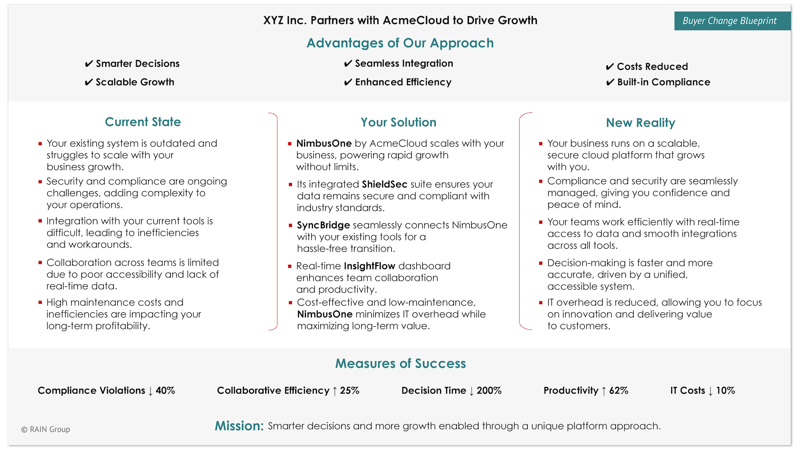
When you can credibly connect your capabilities to the buyer’s desired outcomes, your value case becomes much stronger.
Test and Refine the Value Case with Your Buyer
Your preparation gives you a stronger starting point, but don’t mistake research for validation. Public financial information can help you develop hypotheses, but it can’t tell you what’s happening inside the business.
Avoid arriving with a finished business case built on assumptions the buyer hasn’t validated. Instead, use the executive conversation to test what you think you know: which pressures and priorities matter most? How does the organization measure improvement? What would need to change for the investment to be worthwhile? What evidence will be needed to support a decision?
The value case should become more specific as you learn. Confirm the assumptions that hold up, correct the ones that don’t, and incorporate information you couldn’t have known before the conversation. The goal is a value case the buyer recognizes as grounded in their business, not just in your solution.
Adapt Your Value Case Across the Buying Team
In complex enterprise sales, senior executives rarely make decisions alone. Other members of the buying team will evaluate the same investment through different lenses based on their responsibilities, priorities, and measures of success. Developing financial acumen will help you tailor the value case across the buying group.
While your underlying case may be the same, the value story should reflect what matters to each stakeholder. A CFO may focus on return, margin, cash impact, and risk; a COO may focus on productivity and operational performance; a CRO may focus on growth, retention, and sales efficiency. Other stakeholders may care about implementation, adoption, compliance, or disruption to the business.
As you build support for the decision, identify who is involved, what outcomes they’re accountable for, and what evidence each person needs. A strong enterprise value case gives the buying team a shared reason to act while making the value relevant to the individuals involved in the decision.
Build the Value Case Around the Buyer’s Business
Developing financial acumen will give you the raw material for a stronger C-suite value case. Use financial information to understand the company’s Current State, identify where meaningful gaps may exist, and connect your capabilities to measurable outcomes that will help them achieve a better New Reality.
Support that connection with credible evidence, then use the executive conversation to validate what matters and strengthen the case. When you can connect your solutions to the financial and strategic results executives are accountable for, you’ll be better positioned to have the kind of conversations C-suite buyers value.