





Even in a professional environment, connecting with others on a personal level can build lasting relationships and unlock new opportunities. Sometimes, doing so is quick and seamless. Other times, it takes a while to establish that connection—if it happens at all.
However, with practice, anyone can learn to build rapport.
For sellers, rapport sets the tone for the sales process. If you can start building it early, it’ll ease communication, establish trust, and increase the odds of you winning the sale.
What is Rapport in Sales?
Rapport is an especially congenial, sympathetic, and cooperative relationship. In the sales world, building rapport means gaining a person’s trust by showing concern for their needs and communicating well. Building rapport is essential for sales success, which is why it’s the ‘R’ in RAIN Selling.
The Importance of Building Rapport
If you want to be a successful salesperson, you need to get comfortable with skepticism. Why? Because people have doubts about one another. In its Trust and Distrust in America report, Pew Research Center found that 71% of Americans think interpersonal confidence has worsened in the past two decades. Nearly half of Americans think the reason is unreliability.
For salespeople, it’s safe to assume that a certain level of skepticism is the norm.
It’s not all bad news, however. That same Pew Research report found that nearly six in 10 Americans think building confidence in each other is highly important. People want to trust each other, despite rampant skepticism. And people want to buy from people they know, like, and trust. The way to earn that status is to focus on building and maintaining relationships, and not only on the transactional nature of closing a deal.
Connections are everything in sales, and rapport is a gateway to building more of them. Even if you’re not talking with a key decision maker, mutual trust makes it more likely that you’ll be able to leverage your connection to reach one. Not only that, but rapport can help you build buyer champions to advocate for you when you’re not in the room.
If all goes well, you’ll be able to gain confidence in your solutions, educate buyers on new possibilities, and generate more referrals.
Basics of Rapport Building
So, how do you build rapport with buyers? The first step is to make the time and space for it. Really! People can pick up on even subtle indicators of disinterest, boredom, or hurry. Be human and conversational. Say hello, make eye contact, and break the ice.
If you're meeting with multiple people, fill time with conversation while you wait for others to show up. Unless you can tell the buyer wants to jump into business with military precision, do what you can to build rapport early in your conversation.
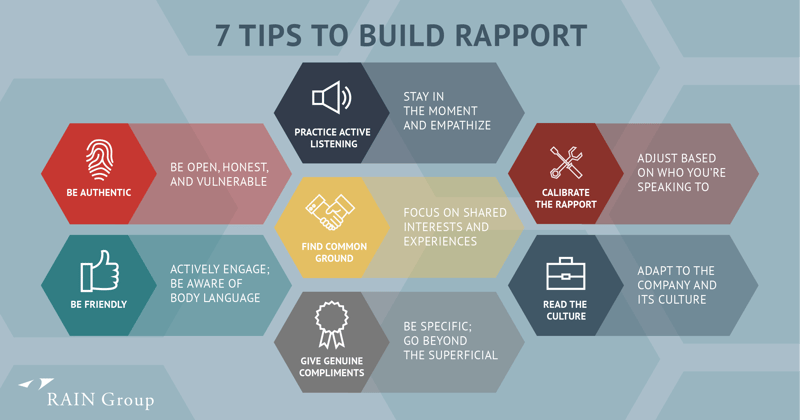
But be careful to make a sincere connection. Too often, chit-chat seems contrived because it feels forced, generic, or superficial. To achieve a level of sincerity and build true rapport before, during, and after your calls and meetings, try these seven strategies.
And remember, while establishing immediate rapport is a great way to move a sale forward, don't be discouraged if you don't connect right away. Identifying a buyer's communication preferences is an ongoing process.
Connect with buyers and discover needs. Download 50 Powerful Sales Questions. >>
7 Tips for Building Rapport in Sales
Rapport-Building Tips
- Be authentic
- Be friendly
- Practice active listening
- Find common ground
- Give genuine compliments
- Calibrate the rapport
- Read the culture
1. Be authentic
Understanding yourself is the first step to building rapport. Even without knowing you personally, your prospects can recognize when you're putting on an act or delivering a rehearsed pitch.
Then again, “be yourself” can be a bit of a cliche too. What does it actually mean for salespeople?
- Don't try to be anything you're not, create a new persona, or adopt a "sales-like" tone.
- Relax, smile, and go in with a positive attitude.
- Give genuine compliments. Don’t say you like the buyer’s office if, deep down, you think it’s tacky.
- Try not to overdo it, as most buyers equate over-friendliness and saccharine smiles with fakeness.
- Ask questions and solicit advice to show vulnerability, encourage cooperation, and facilitate sharing.
2. Be friendly
Cold people get cold reactions from others. Even if you’re not the warmest person in the world, there are still some simple ways to be warm and friendly. Smile, for one. Give a firm handshake, make eye contact, and engage with the person in front of you.
Again, avoid “forcing the friendliness.” Most of us know someone who wanted to be liked so much that it showed. That person likely appeared needy and conspicuous, which are not ideal perceptions to engender during a sales call. We’ve found that asking follow-up questions is a great vehicle for coming across as friendly and conversational (more on that later).
3. Practice active listening
Tunnel vision isn't good for building rapport. People are often self-focused, but sellers will find it difficult to build rapport if they only focus on closing the deal—especially if it’s at the expense of learning about buyers, hearing their needs, and crafting a tailored solution.
Buyers want the opportunity to share what they're thinking, including their desires, fears, and problems. More importantly, they want to feel like they're being heard. The more you can show you're listening to them by making the effort to relate, the more likely they are to keep talking.
Active listening can mean asking strong follow-up and clarification questions, nodding and verbally responding to what the buyer is saying and displaying interest in them as a person. If you have multiple conversations with a buyer, bring up details from your previous interactions with them. Make a point to remember names in particular.
I’m talking about empathy. Empathic sellers are:
- Aware of what’s going on here and now, rather than thinking of what they’re going to say next
- In-tune with the buyer's verbal and non-verbal cues
- Capable of discussing buyers’ goals and challenges without pitching
- Consistent about following up
- Mindful of the difference between empathy and sympathy
What Are Verbal vs. Non-verbal Cues in Rapport?
Throughout the course of a sales conversation, all parties communicate through cues. Cues are indicators of an expectation that hasn’t been made explicit, through body language, signals, and manners of speech.
Non-verbal cues consist of body movements, gestures, and other ways of communicating expectations with the body. When a person looks in a certain direction, does something with their hands, or slouches with their arms crossed, they’re communicating.
Verbal cues consist of how and what we speak, including speaking up, quieting down, repeating words, or modifying tone of voice.
When it comes to building rapport, it’s important to attend to both verbal and non-verbal cues.
4. Find common ground
When it comes to people, like attracts like. The more you can uncover shared interests, the greater your ability to build rapport. Maybe you:
- Went to the same school
- Lived in the same city
- Have children of similar ages
- Enjoy the same TV shows, sports interests, or hobbies
- Have shared connections
These are similarities. Similarities pave the way to a stronger connection.
Another way to find common ground is through shared experience. This is all about interaction and collaboration. It’s easily confused with a similarity, but the two aren't the same:
- Similarity = “We’re both fans of golf”
- Shared experience = “Let’s play golf together”
Even spending a short time together on a casual game of golf, dinner, a cup of coffee, or attending an event is enough to move from the “stranger” category to “friend.” But don’t restrict your thinking to a traditional in-person experience. If you’re selling in-person or virtually, you can create shared experiences through interactions. For example, how you come together to:
- Define a problem
- Craft a solution
- Devise a strategy to present the solution
- Work collaboratively to come to the right agreement and terms
Done well, sharing experiences creates the feeling that you and the buyer are working towards a common goal and are on the same team. When you do this, buyers like you more and are much more likely to take action.
5. Give genuine compliments
Sycophants get nowhere, but genuine compliments are endearing. If you like their office, a buyer's website, or are impressed with the books on the wall, say so. If the buyer had a recent accomplishment, relay your authentic congratulations.
To avoid coming across as insincere:
- Ask yourself if you actually care about what you’re complimenting
- Go beyond superficial details that anyone could mention
- Resist the urge to lay it on heavy by picking your moments
6. Calibrate the rapport
New sellers are often sensitive to a buyer’s time. They may think that a CEO has no time to chat and dive right in without an ice breaker. Others spend too much time chatting and don't notice the buyer wants to get down to business.
In both situations, the culprit is assumption. Instead of assuming the CEO has little time, start building rapport and adjust based on the feedback you’re receiving.
Read the other person's verbal and non-verbal cues to calibrate your relationship building.
Most people practice a behavior called mirroring, in which they imitate whoever they're speaking to, consciously or not. Mirroring can help build rapport if done subtly. Consider matching the buyer's tone, body language, or speech patterns when appropriate.
Tips on Building Rapport Virtually
How do you build rapport in virtual environments or remote meetings? Calls and conferences with multiple people are especially challenging. Here are some tips:
- Turn your video on
- Find common ground in the circumstance necessitating a video call
- Work with people to solve connection issues (be part of the solution)
- Follow up on things mentioned in the video call
Click here for 20 virtual sales relationship-building tips. >>
7. Read the culture
While you should strive for authenticity, remember to adjust your approach to the buyer and their company. Don't change who you are to fit the culture, but be aware of how the culture works and might impact your conversation.
For example, you might not want to show up to a suit-and-tie-type operation in your tie-dyed Grateful Dead ’95 shirt (unless you're meeting with me, in which case I'd be impressed). And you might want to dial back your choice of attire and approach for the jeans-and-sneakers shop with the "Never Lose Your Whimsy!" sign on the wall.
Finally, do yourself a favor: avoid bashing. I’ve seen too many sellers get too comfortable, too early, only to assume they’re clear to openly bash something. Whether it’s a politician, sports, or the weather in Siberia, the rest of the call is going to be painful if you assume incorrectly.
How to Build Rapport by Asking the Right Questions
Questions get people to talk about themselves, and people love talking about themselves. If you want to develop a relationship with your buyer and be a more successful seller, give your buyer the opportunity to share what they're thinking. Here’s an example:
Seller: “I know this is a new role for you. How is it so far? Is life any better?”
Buyer: “Well, I’m not on the road so much. That means I’m spending a lot more time with my son.”
Seller: “Oh yeah? How old is your son?”
Buyer: “He’s 10. So it’s great that I can be around more. Now I’m home to eat more meals with my family, you know?”
Seller: “I’m with you. You can’t place a price on a home cooked meal. Ten is such a great age. My kids are 11 and 8. And they’re always on the go. Yours must keep you busy, as well?”
Rapport Building Isn’t a Sales Script, It’s a Discipline
You can memorize all of the scripts, talk tracks, and scenarios you want. But you can’t script being yourself, showing real interest, or any of the other tips shared above. In many ways, these are intangible skills with tangible means of execution. And sometimes, the buyer still might not respond the way you want.
Building rapport is often a feel. It’s about instincts and emotional intelligence. And these qualities are developed over time by consistently applying some of the tips and tangibles we’ve listed above. If you’re wondering how to build better rapport in your sales relationships, change your approach and treat this particular skill like a discipline. Work on it. Hone it. Try, fail, and refine—over and over again.
Once you do that, you'll be well on your way to creating the lasting sales relationships you're looking for.